
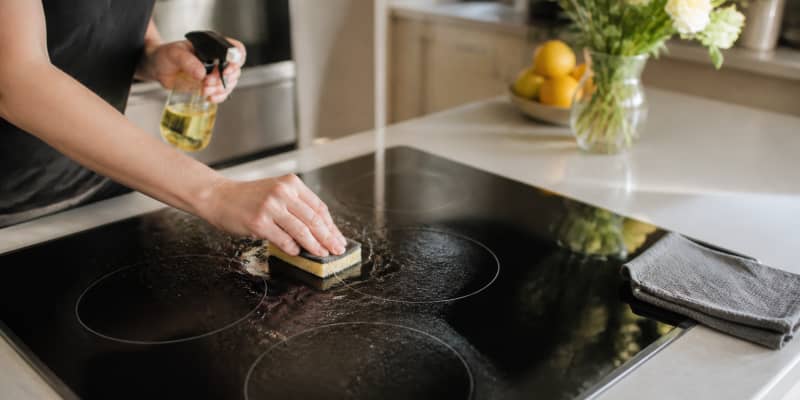
A boiled-over jam pan, a shattered toffee syrup or a sticky spill from a Christmas pudding basin can bond to a hot hob in seconds, and the temptation to scrape it off with a knife is exactly what ruins the surface. Sugar sets far harder than gravy or oil because it re-crystallises as it cools, welding itself to glass or metal. Here is how to remove burnt sugar from a hob safely, whether you have ceramic, induction or stainless steel — and how to do it before it becomes a scratch, an etch mark or a professional job.
Quick answer
To remove burnt sugar from a hob, act while the surface is still warm — not hot. Wet the deposit with warm soapy water, cover it with a damp cloth for 10 minutes to let steam soften the caramel, then lift the softened sugar with a plastic hob scraper held at a 30-degree angle. Finish with a dedicated hob cream such as Cerapol or Hob Brite and buff with a soft microfibre. Never use a metal knife on ceramic or induction glass.
Why burnt sugar is different
Sugar caramelises at around 170 °C and, once it goes past that, it fuses with the glass or metal surface as it cools. Unlike oil splatters — which sit on the surface — molten sugar flows into microscopic imperfections in the ceramic and then crystallises there. If you let it drop to room temperature it becomes rock-hard, and pulling it off can lift the printed hob markings or scratch the glass. The trick is to catch it in the warm sticky phase, when steam still shifts it easily.
Read also: How to clean a ceramic hob
What you will need
- Plastic or ceramic hob scraper (never metal) — Cerapol scrapers cost about three pounds
- Hob cream — Hob Brite or Cerapol are the UK favourites; Astonish Specialist Ceramic Hob also works
- Warm soapy water and a soft sponge
- Microfibre cloths — keep one dry for the final buff
- Bicarbonate of soda for stubborn residues
- A pair of oven gloves — the hob will still be warm
Ceramic hob — step by step
- Turn off the zone but do not remove the pan until the fizzing stops.
- When the hob is warm (touchable) drape a soaking wet cloth over the sugar.
- Leave for 10 minutes so the steam softens the caramel — resist the urge to peek every minute.
- Hold the plastic scraper at 30 degrees and shear the softened sugar off in one direction.
- Wipe with soapy water, then apply hob cream in circular motions with a soft cloth.
- Buff dry with a clean microfibre — the finish should feel silky, not gritty.
Read also: How to clean an induction hob
Induction hobs — same idea, gentler
Induction glass is chemically identical to a ceramic hob but often has a printed pattern of coil markings that shows scratches instantly. Use exactly the same steamed-cloth method, but skip any powder cleaner. Cerapol or Hob Brite creams are safe. Never use scouring pads, oven cleaner or bleach — the solvents can etch the coil markings and, unlike burnt sugar, that damage is permanent. Bosch, Neff and AEG all specifically recommend a plastic scraper and a soft-cream cleaner in their care manuals.
Stainless steel hobs and pan supports
On gas hobs the burnt sugar tends to land on the pan supports and drip trays rather than the flat top.
- Lift the supports off and soak in a sink of hot water with a Finish or Fairy dishwasher tablet for an hour
- Scrub with a nylon brush, not wire wool
- Polish the stainless top with Bar Keepers Friend, following the grain of the metal
- Rinse and dry immediately to avoid water spots — stainless steel picks up limescale rings in hard-water areas within minutes
- For cast iron pan supports, dry with a tea towel and warm on the hob for two minutes to prevent rust
Read also: Remove burnt-on grease from an oven
If the sugar has fully hardened overnight
Do not panic and reach for a knife. Instead, boil a kettle and pour a small pool of hot water directly onto the deposit — the temperature difference softens the surface without shocking cool glass. Cover with a damp cloth and leave for 20 minutes. Follow with the scraper. If the sugar is more than one millimetre thick, repeat once. A paste of bicarbonate of soda and a few drops of white vinegar reactivates any last patches — leave for five minutes then wipe.
What not to do
- Do not pour cold water on a hot hob — thermal shock can crack the glass
- Do not use a kitchen knife or metal scraper on ceramic or induction
- Do not spray oven cleaner on hob glass — the caustic strips the printed markings
- Do not scrub with green scourers — they leave hairline scratches that trap future spills
- Do not leave sugar overnight expecting to sort it in the morning
How to stop it happening again
Cook sugary syrups and jams in a pan taller than half full and reduce the heat as soon as the mixture starts to climb. Keep a jam funnel and a heatproof spatula within reach so you can lift the pan the moment things move. For toffee or fudge — the two worst culprits — put a baking tray under the pan to catch drips before they hit the hob at all. In UK kitchens with radiant ceramic hobs, dial back to the second-lowest setting once the sugar starts to bubble: caramel will keep working from residual heat.
Conclusion
Catch burnt sugar in the warm, sticky window and it lifts off easily; leave it overnight and it becomes a professional job. A plastic scraper, a wet cloth and a squeeze of hob cream is all it takes — no bleach, no wire wool, no thermal shock. For hardened deposits, damaged ceramic or a full kitchen refresh before an inspection, book a deep clean with Maggie’s appliances cleaning in London.
