
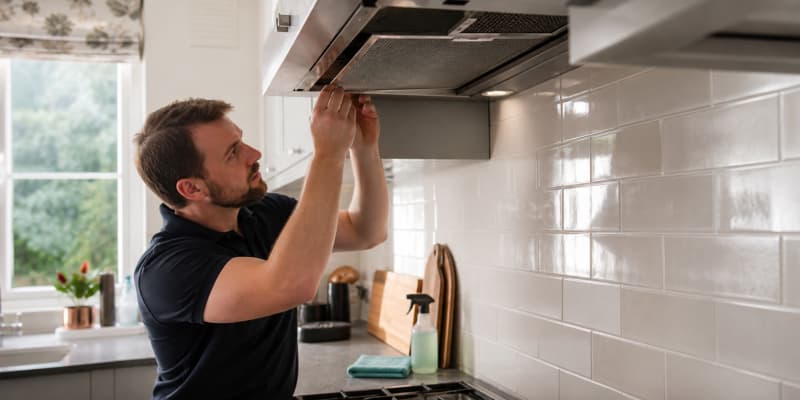
Grease creeps past filters and clings to the inside of ducting, restricting airflow and adding a real fire risk over time. Most of us change the filters and think the job is done — but the invisible layer building up inside the metal or plastic pipework is what quietly kills extraction and, in worst cases, ignites during a chip-pan flare. Learning how to clean a range hood duct properly — not just the filters — is what actually restores performance, stops smells re-entering the kitchen and keeps insurers happy in any home food-business setup.
Quick answer
To clean a range hood duct, isolate the power at the wall socket, remove the grease and carbon filters, and access the ducting through the hood housing or an inspection hatch. Spray a kitchen degreaser onto the visible duct walls, wait ten minutes, then work a long-handled brush wrapped in a degreaser-soaked cloth up and down the pipe. Finish with a damp microfibre rinse, dry, and refit the filters. Aim for once a year in a domestic kitchen.
Why duct cleaning matters
Even a well-filtered hood lets some fine grease vapour through, and that vapour condenses on the cool walls of the duct. Over months a soft, sticky coating turns into a hard glaze that narrows the pipe. Airflow drops, the motor works harder and — in worst cases — flash fires can travel along the duct all the way to the roof cowl. Commercial kitchens are legally required to clean extract ducting under TR19 guidance for exactly this reason, and buildings insurance for both restaurants and rental properties often depends on documented cleans.
Read also: TR19 kitchen extraction cleaning explained
Tools and materials
- Heavy-duty kitchen degreaser (Elbow Grease, Astonish Oven & Grill or KH-7 all work well)
- Long-handled flexible bottle brush or rotary duct brush from a drain-cleaning set
- Microfibre cloths and a bucket of warm water
- Rubber gloves, safety goggles and old clothes — this is a messy job
- Torch and dust sheet to protect the hob below
- Step ladder tall enough to reach the top of the hood comfortably
How to clean a range hood duct step by step
- Switch off the hood at the wall and, if possible, at the consumer unit.
- Cover the hob with a dust sheet and remove the grease filters — drop them straight into a sink of hot soapy water.
- Shine a torch up into the ducting to check the run length, direction and any bends.
- Spray degreaser onto the visible duct walls and leave for 10 minutes so it softens the glaze.
- Push a long brush wrapped in a degreaser-soaked cloth up the duct and rotate as you withdraw it.
- Repeat, refreshing the cloth, until it comes back clean.
- Finish with a damp microfibre rinse and dry the first 30 cm of duct — moisture there causes fresh smells.
- Refit clean filters and run the hood on high for two minutes. Airflow should feel visibly stronger.
Read also: How to clean a cooker hood filter
Reaching further into the ducting
Domestic ducts are typically 100–150 mm wide and run vertically to a soffit or horizontally through an external wall. Anything beyond arm’s length usually needs a rod-and-brush kit — the same tools plumbers use for drains. Screw-together fibreglass rods with a nylon brush head cost around twenty-five pounds and reach three or four metres. If your run has bends, elbows or terminates in a roof cowl, a professional deep clean is safer than dismantling ceiling boxing yourself; taking down plasterboard to reach the duct is a job that quickly turns into a redecoration.
External vent check
- Look at the outside wall louvre — flaps should open freely under airflow
- Remove any spider webs, leaves or bird debris behind the grille
- Check the flap closes fully to stop cold draughts in winter
- Clean the exterior louvre with a soft brush — do not force the flaps open
Read also: Clean a recirculating extractor hood
How often should you clean the duct?
For a domestic kitchen used daily, clean the duct once a year — spring is ideal, before summer opens windows onto the same air. If you fry, wok-cook or run a home food business, drop that to every six months. Commercial kitchens should follow TR19 intervals — quarterly for heavy use, six-monthly for moderate, annually for light-use kitchens. Landlords cleaning a rental between tenants should always include a duct check; a smoky hood is one of the most common tenancy inspection failures.
Warning signs your duct needs attention
- The hood is louder than it was six months ago on the same setting
- Cooking smells drift into other rooms even with the fan on high
- A dark oily line appears on the ceiling above the hood exit
- The exterior louvre outside the house looks stained or drips brown on rain days
- Filters saturate faster than they used to
When to call a professional
Any duct longer than three metres, a run with more than one bend, or a roof-terminated cowl is a professional job. Insurance-backed deep cleans come with photographic before-and-after evidence, which matters for landlords and food businesses. If you have never had the duct cleaned since the hood was installed and the property is more than five years old, expect a heavy first-time clean — after that, annual maintenance is straightforward.
Conclusion
Cleaning the exhaust duct — not just the filters — is what actually restores hood performance and keeps your kitchen safe. It takes an hour once a year and pays back in stronger extraction, quieter fans and less kitchen smell in the wardrobe upstairs. For heavily glazed commercial ducts, insurance-compliant TR19 work or awkward roof-terminated runs, book a specialist deep clean with Maggie’s commercial kitchen cleaning in London.
