
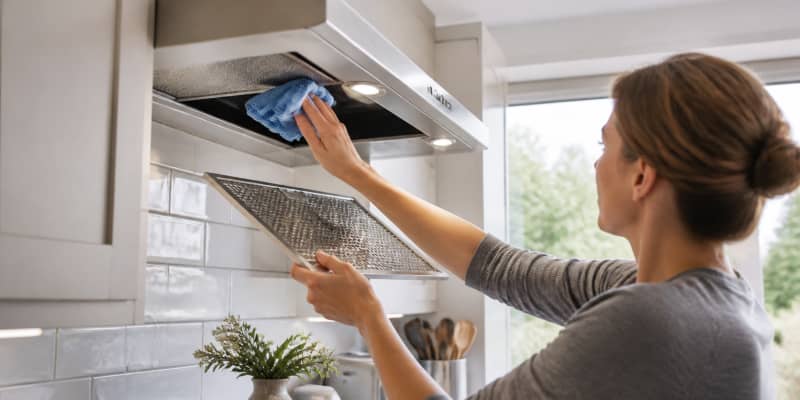
A recirculating hood does not vent outside — it filters cooking air through a grease filter and a carbon filter, then blows the cleaned air back into the kitchen. That closed loop means every part of it collects grease faster than a ducted extractor, and every part of it needs cleaning. Learning how to clean a recirculating extractor hood properly, from the metal filter through to the fan housing, keeps the air in the kitchen genuinely clean.
Quick answer
To clean a recirculating extractor hood, isolate the power, remove the grease filter and soak it in boiling water with bicarbonate of soda for thirty minutes, replace the carbon filter, and wipe the canopy and fan housing with a degreaser. Refit everything only once dry. Repeat the process every six to eight weeks in a family kitchen.
Recirculating vs ducted — why cleaning matters more
A ducted extractor hood sends greasy air out of the building. A recirculating hood — sometimes called a recirculating hood or a cooker hood without external ducting — pushes that air through a carbon filter and back into the room. Everything the filters do not catch stays in your kitchen. That puts more pressure on both filters, on the fan blades behind them, and on the underside of the canopy. If you can smell yesterday’s fish on toast this morning, your recirculating hood is telling you it is time.
Read also: How to clean a cooker hood filter
What you’ll need
- Rubber gloves
- Bicarbonate of soda
- Washing-up liquid — Ecover or Method
- A degreaser such as Astonish Kitchen Cleaner or Bar Keepers Friend
- A soft brush or old toothbrush
- Two or three e-cloths
- A replacement carbon filter matched to your hood model
- A kettle of near-boiling water
- An old towel for the counter under the hood
Step-by-step method
- Isolate the hood at the wall switch and let any lights cool.
- Lay a folded old towel across the hob to catch drips.
- Slide the metal grease filter out. Set it in the sink.
- Remove the carbon filter — usually a round disc that unclips or unscrews behind the grease filter. Bag it for the bin.
- Pour a kettle of boiling water into the sink over the grease filter, add two tablespoons of bicarbonate of soda and a squirt of washing-up liquid, and leave for thirty minutes.
- While the filter soaks, spray a mild degreaser on the underside of the hood canopy and the visible fan housing above. Do not spray directly into the fan motor.
- Wipe the canopy in one direction with an e-cloth, working from the back forward.
- Use a soft brush around the fan cage and any louvres that direct the air back out. Cotton buds handle the corners.
- Scrub the soaked grease filter with a brush, rinse and dry with an old towel.
- Fit the new carbon filter, then the cleaned grease filter.
- Restore power and run the extractor on low for two minutes to confirm normal airflow.
Cleaning the fan housing safely
Where grease hides
The blades of the fan and the plastic housing that surrounds them are where old kitchens end up worst. Grease builds up unevenly, the fan slows down, and the whole hood becomes louder.
How to reach it
Most modern recirculating hoods let you access the fan housing after removing the grease filter — you should see the metal cage right above. If it is hidden behind a plastic cover, do not force it. Some models require an engineer to open.
What to use
Damp e-cloth with a drop of Ecover, worked around each blade with the power off. Never spray directly into the motor.
Read also: When to replace carbon and grease filters
Outer canopy and controls
Stainless-steel canopies clean with a spray of Method Stainless Steel or a paste of Bar Keepers Friend, applied with the grain of the metal and buffed with microfibre. For a glass canopy, use warm soapy water and a soft e-cloth — no ceramic hob cream, which leaves a chalky film. The control buttons or touch strip take only a barely damp cloth; never spray cleaner directly onto them.
How often to clean
Grease filter: every six to eight weeks in a family kitchen. Carbon filter: replace every three to six months. Canopy and fan housing: every eight to twelve weeks. Outer stainless steel: whenever you wipe the hob. If you cook with a lot of oil or fry frequently, treat these as the shortest end of each range. Frying at high heat, in particular, throws far more grease into the air than boiling or steaming, and a recirculating hood is the last line of defence before that grease lands on cabinets, walls and ceilings.
Conclusion
A recirculating hood only cleans the air as well as its filters and its fan let it. Wash the grease filter, replace the carbon filter, wipe the fan housing gently, and buff the canopy with the grain. If yours has been running for a year without a proper strip-down, book our appliances cleaning service in London and we will restore the hood inside and out.
