
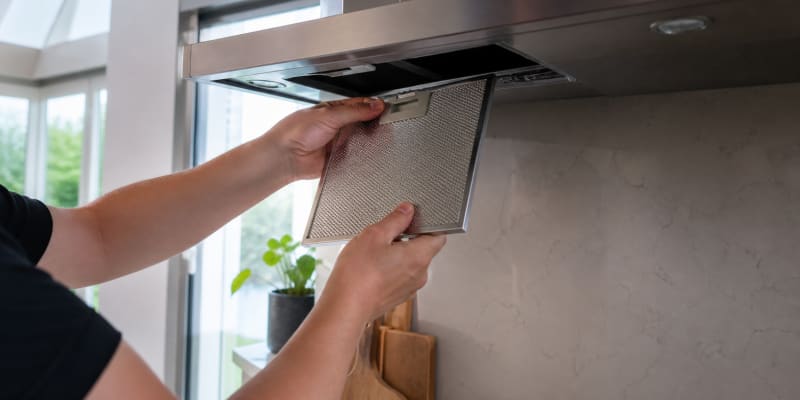
A tired cooker hood chokes airflow, spreads cooking smells through the house and drops a sticky film on nearby cabinets, worktops and even the ceiling above the hob. It creeps up on you — a Sunday roast still lingers on Monday morning, the fan sounds strained, and the tiles beside the burners feel tacky to the touch. Learning how to replace cooker hood filters — both the aluminium grease mesh and the activated carbon cartridge behind it — restores extraction power in minutes and keeps your kitchen breathing. Best of all, it is a job most homeowners can do themselves in under fifteen minutes with no tools.
Quick answer
To replace cooker hood filters, switch the hood off at the wall socket, press the small tab on each aluminium grease panel and lower it into your palm, then unclip or twist out the round carbon filter behind it and press the replacement into place. Change grease filters every two to three months and carbon filters every three to six months on a recirculating hood. Never run the fan without both fitted — grease will coat the motor.
Grease filter vs carbon filter
The two filters do very different jobs. A grease filter is the aluminium mesh you see when you look up into the hood — it traps airborne fat and can be washed in hot soapy water or the dishwasher. A carbon filter sits behind the grease filter on recirculating hoods and uses activated charcoal to strip out cooking odours before pushing filtered air back into the room. Ducted hoods vent to the outside through a wall or roof and usually have no carbon filter at all. If you are unsure which you have, look above the hood — a flexible duct disappearing into the ceiling means ducted; a return grille above the front lip means recirculating.
Read also: How to clean a cooker hood filter
Tools you’ll need
- Replacement grease filter panels (universal or model-specific)
- Replacement carbon cartridge — order by model number
- Step ladder or sturdy chair, ideally with a rubber foot
- Kitchen degreaser and a microfibre cloth for wiping the housing while filters are out
- Rubber gloves — old grease is unpleasant on bare hands
When to replace each filter
Grease filters can be washed several times before they need replacing — swap the whole panel when the mesh is deformed, discoloured or no longer flat. Carbon filters cannot be washed. Once saturated they simply stop absorbing smells and start to smell themselves. If your carbon cartridge feels heavier than the new one you have in hand, it is fully loaded.
Replacement intervals
- Grease filter: deep clean every 2–3 months, replace every 12 months on a busy hob
- Carbon filter: replace every 3–6 months, or after 200 hours of cooking
- Both filters: sooner if you fry regularly, cook curries, or run a woodburner in the same room
- Small London flat with an open-plan kitchen: err on the shorter end — smells travel further
How to replace cooker hood filters step by step
- Turn the hood off at the wall socket, not just the switch on the front — the motor stays live even when the fan is off.
- Push the small tab on each grease filter panel and lower it into your palm. Most hoods have two or three panels.
- Soak the old grease filter in hot water and washing-up liquid if you plan to reuse it — 20 minutes is usually enough.
- Locate the round or square carbon filter behind the grease filter. Twist counter-clockwise or squeeze the clips.
- Wipe the exposed motor housing with a degreaser-damp cloth — this is your only easy access to it.
- Fit the new carbon filter — twist clockwise until it clicks into place.
- Refit a clean grease panel. Listen for the tab clicking home.
- Restore power and test the hood on high for one minute; you should feel a clear pull at the front lip.
Read also: Clean a recirculating extractor hood
Buying the right replacement filter
Universal grease filters come in large sheets and can be cut to size with scissors, but carbon filters are almost always model-specific. Note the appliance model number — printed on the rating plate inside the hood, usually visible only once the grease filters are out — before ordering. Bosch, Neff, Siemens, Elica and Hotpoint each publish part numbers for their carbon cartridges. Reputable UK suppliers include Currys Spares, eSpares, 4YourHome and manufacturer parts sites. Expect to pay around eight to fifteen pounds for a genuine carbon filter and three to five pounds for a metal grease panel.
Signs your filters are failing
- Weak suction even on the highest fan setting
- Cooking smells linger for hours after you finish
- Sticky residue on cabinet doors and tiles beside the hob
- Visible discolouration, tears or bent mesh in the grease filter
- A faint stale smell coming from the hood itself when it is switched off
Common mistakes to avoid
Do not put a saturated grease filter back after just wiping it — the mesh needs to breathe, not just look clean. Never fit only one of the two filters on a recirculating hood; the extractor pulls unfiltered smoke straight into the motor. Do not use vinegar on the carbon filter — moisture ruins the activated charcoal. And never assume “the fan sounds fine, so the filters are fine” — the motor spins the same whether or not it is pulling any air through.
Read also: Clean a range hood exhaust duct
Conclusion
Regular filter changes protect your kitchen from grease build-up and keep your hood pulling smoke and steam out of the air. Grease panels every two months, carbon cartridges every three to six months, and a wipe of the motor housing while everything is out — that is all it takes. If your hood housing, ducting or fan blades need a deep clean alongside new filters, book a professional appliance clean at Maggie’s appliances cleaning in London.
