
The TR19 kitchen extraction standard is the UK benchmark for cleaning grease-laden ductwork above commercial cookers. Understanding it matters because insurers, EHOs and fire risk assessors all reference TR19 (now TR19 Grease) when judging whether an extract system has been properly maintained. If you run a restaurant, hotel, pub kitchen, dark kitchen or care home in London, this standard is the difference between a covered claim and an uninsured fire loss.
Quick answer
TR19 Grease is the BESA specification for cleaning kitchen extract ductwork. It sets minimum frequencies (from monthly to yearly depending on use), defines cleanliness by measuring grease thickness in microns, and requires photographic evidence and a certificate on completion. Non-compliance can void your insurance and trigger EHO enforcement.
Why TR19 matters
Grease deposits inside extract ducts are one of the leading causes of commercial kitchen fires in the UK. Once a fire starts in the canopy, the duct acts as a chimney straight through the building. Insurers now routinely refuse claims on kitchen fires where the extract system has not been cleaned to TR19 standard.
The standard was published by the Building Engineering Services Association (BESA), updated to TR19 Grease in 2019, and separates grease work from general ventilation hygiene under TR19 Air. Compliance is not required by law directly, but it is written into most commercial insurance policies as a warranty condition, and referenced by the Regulatory Reform (Fire Safety) Order 2005 for the “responsible person” duty.
Read also: EHO compliance checklist for UK commercial kitchens
What TR19 cleaning actually covers
A compliant clean covers the entire extraction system, not just the visible canopy:
- Canopy interior and grease filters.
- Plenum chamber above the filters.
- All accessible horizontal and vertical ductwork.
- The extract fan housing and impeller.
- Termination point on the roof or wall.
- Fire dampers, if fitted.
Access panels are installed where none exist so that every metre of duct can be inspected and cleaned; TR19 requires access at every 3 metres of duct run, every change of direction and at the fan. After cleaning, a wet-film thickness gauge (or deposit thickness test) measures the grease layer at multiple points; deposits above 200 microns are considered a fire risk and fail the standard.
How often you need to clean
TR19 sets minimum frequencies based on hours of use per day:
- 12-16 hours a day (heavy use, e.g. hotels): every three months.
- 6-12 hours a day (typical restaurant): every six months.
- 2-6 hours a day (light use, e.g. small cafe): every 12 months.
High-grease cooking such as wok, grill or fryer-heavy kitchens may need cleaning more often even within a given category. Deposit measurements at each visit help you calibrate the right interval; if levels are consistently below 100 microns you may be able to stretch, and if they are above 200 you must shorten.
Read also: How to clean a range hood exhaust duct
What good documentation looks like
A TR19 clean should produce a written report and certificate including:
- Before and after photographs at every access point.
- Deposit thickness measurements.
- A schematic showing every access panel and where readings were taken.
- Recommendations for the next clean date.
- Details of the operatives and their competency (CSCS, Ventilation Hygiene Technician).
- BESA or B&ES accreditation reference for the contractor.
Keep certificates for at least six years; insurers frequently ask to see the last three. Many now require certificates uploaded to their portal within 14 days of the clean.
How the clean is carried out
TR19-compliant cleaning is carried out out-of-hours to avoid contaminating food areas. Typical process:
- Isolate power to the fan and lock off.
- Sheet the kitchen with polythene.
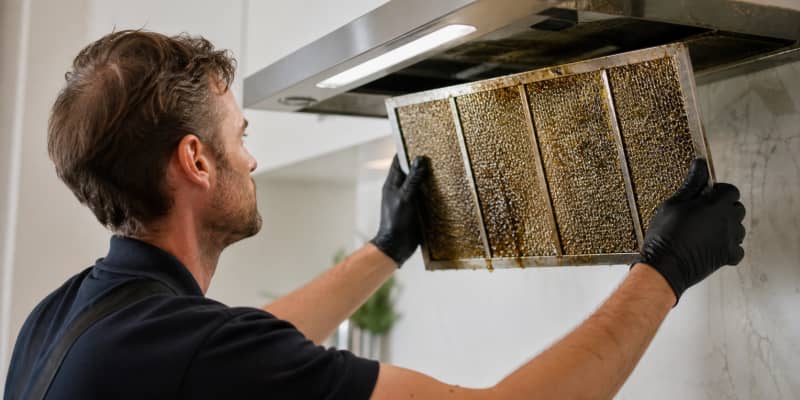
- Remove filters and soak in a heated dip tank.
- Open or fit access panels along the duct run.
- Scrape and manually clean each duct section, using biodegradable degreasers.
- Clean the fan impeller and housing.
- Photograph, measure and reinstate all panels.
- Provide certificate and photographic report within 5 working days.
Read also: How to clean a cooker hood filter
Common findings on first-time TR19 cleans
When we take on a new site, we frequently find:
- No access panels at all, requiring retrofit before the clean can proceed.
- Filters that have never been washed, blocking 40 per cent of the airflow.
- Grease deposits over 500 microns in the plenum chamber.
- Fan impellers so heavily coated they wobble on the shaft.
- Missing fire dampers where the duct passes through a fire wall.
None of these are cosmetic issues; all reduce cover under a typical commercial policy.
Frequently asked questions
Is TR19 legally required?
Not directly, but it is referenced by insurers and fire risk assessors, and the Fire Safety Order requires a competent standard of maintenance which TR19 provides.
Can we clean the canopy ourselves?
You can wash filters daily and wipe the canopy interior. TR19 duct cleaning requires trained ventilation hygiene technicians.
Who is the “responsible person”?
Usually the business owner or head chef. They can delegate the work but not the responsibility.
How long does a typical clean take?
For a small single-canopy pub kitchen, expect 3-5 hours out of hours. Larger multi-canopy restaurants can take 8-12 hours, split across two nights if needed.
Do we need to close the kitchen?
Most cleans are done overnight or between services so no daytime closure is needed, provided the kitchen can be sheeted off from any 24-hour operation.
Conclusion
TR19 Grease is more than a paperwork exercise; it directly protects your kitchen from fire and your business from an uninsured loss. Our commercial kitchen cleaning service carries out TR19-compliant extraction cleaning with full photographic reports and certification across London. See our coverage for a bespoke quote.
