
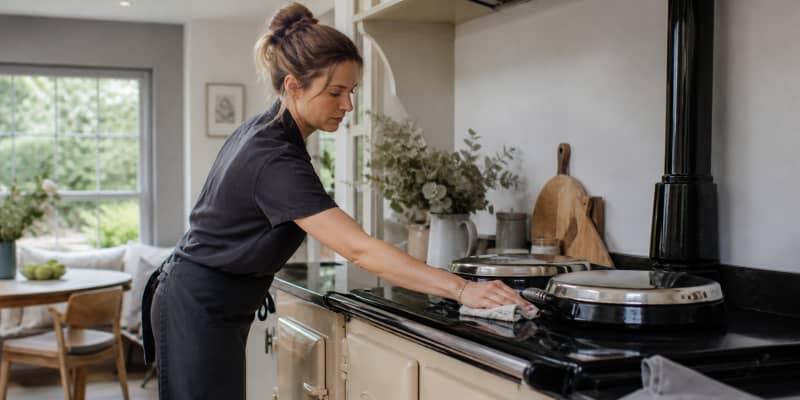
Choosing between Aga vs Everhot vs Rayburn is not just about looks and cooking style; it is also about how much cleaning and servicing each one demands over a lifetime. All three are cast-iron heat-storage cookers, but the day-to-day maintenance differs more than you would think, and so do the long-term running and servicing costs. If you already own one, this guide helps you shape the right routine. If you are choosing between them, it will help you pick with your eyes open.
Quick answer
Aga cookers need the most frequent enamel care because they run hottest and always-on. Everhot is the easiest to clean because it can be turned off and cools completely. Rayburn sits in the middle and adds a solid-fuel or oil boiler service on top. All three share the same do-not-use list: no caustic sprays, no vinegar or lemon juice, no wire wool or melamine sponges.
Cleaning frequency compared
Aga
Always-on Aga models run at 100-240 C on the top plate, so grease sets quickly. Expect a daily wipe, a weekly polish of the chrome lids and enamel front, and a full monthly deep clean of shelves and ovens. Electric Total Control Agas can be switched to slumber for a deep clean, which makes the monthly job easier.
Everhot
Everhot cookers are fully electric with a thermostat that can be turned off. You can cool the cooker for a proper deep clean, which makes weekly maintenance faster. Daily wipes and a monthly enamel polish are usually enough. Because the outside runs cooler, grease sets less aggressively.
Rayburn
Modern Rayburns are gas or oil-fired heat-storage cookers with an optional boiler for hot water and radiators. Cleaning routines mirror an Aga’s, but you also add a yearly heating-engineer service that Everhot users skip. Solid-fuel Rayburns generate soot that needs sweeping from the flue and firebox at least annually.
Read also: Aga cleaning checklist for weekly and yearly care
Products and techniques
All three cookers wear vitreous enamel, so the do-not-use list is identical: no oven-cleaner spray, no lemon juice, no wire wool, no melamine sponges. Bicarbonate of soda paste, warm soapy water and enamel-safe polishes are the shared toolkit. Aga stove polish works well on chrome and enamel across all three brands.
The key differences are the hotplates and lids:
- Aga uses a wire brush on cast hotplates while warm; lids are chrome on classic models, enamel on newer.
- Everhot uses a wire brush on cast hotplates once cool; lids are enamel over insulated cast.
- Rayburn hotplates are cast iron and covered by hinged insulated lids; care is closer to Aga’s.
Read also: Aga cleaning: what NOT to use and why
Servicing and long-term costs
Aga
Oil, gas and solid-fuel Agas need a yearly engineer service to check burners, flue and thermostat, typically 250-450 GBP. Electric Agas need less frequent servicing but benefit from a professional enamel clean every 12-18 months. Total Control Agas have replaceable ovens that add another servicing option.
Everhot
As a fully electric appliance, an Everhot’s servicing burden is very low. There is no burner or flue. Your main investment is a periodic professional enamel deep clean, and occasional element replacement over the very long term. Running costs on cheaper Economy 7 tariffs are competitive with gas.
Rayburn
Rayburn boiler models bring extra servicing: burner and heat exchanger checks, plus flue and boiler safety inspections. Budget for both an Aga-style clean and a heating engineer visit. Solid-fuel Rayburns also need a chimney sweep annually.
Running costs compared
- Aga (oil, always-on): 5-10 GBP per day.
- Aga (electric Total Control, controlled use): 3-5 GBP per day.
- Everhot: 2-4 GBP per day depending on setting.
- Rayburn (with boiler): variable; more expensive without the boiler heating water and radiators.
Which is easiest to live with?
If low-maintenance is the priority and you cook occasionally, Everhot wins. If you want the traditional always-on kitchen heart and don’t mind daily wipes, Aga is unbeatable. If you also want hot water and radiator support from the cooker, Rayburn justifies its extra servicing burden. All three retain resale value well when kept clean.
Read also: Buying a range cooker: 10 things to check
Which is best for a London kitchen?
Small London kitchens often suit a smaller two-oven Everhot 60 or 90, which does not need a flue and can be cooled to save energy in summer. Aga still leads for larger family kitchens with room for a three or four-oven. Rayburn is more common in older houses with existing boiler flues; if you are starting fresh, Everhot or a Total Control Aga usually make more sense.
Cleaning products that work across all three
The good news is your cleaning cupboard for any of these cookers is nearly identical. Stock Aga stove polish, Bar Keepers Friend, bicarbonate of soda, washing-up liquid, and a set of colour-coded microfibre cloths. The wire brush supplied with each cooker is model-specific but the technique is the same: dry brushing while the plate is warm, never wet. If you switch from an Aga to an Everhot in a house move, the same routine transfers with only minor adjustments.
Resale value and long-term care
All three brands hold their resale value remarkably well; a 20-year-old Aga in cream with clean enamel can still fetch 3,000-5,000 GBP on the second-hand market. Everhot cookers are newer to the market but their electric simplicity means fewer moving parts to fail, and used Everhots also sell strongly. Whichever cooker you own, an up-to-date service history and photographic evidence of periodic professional cleaning add hundreds of pounds to the sale price.
Conclusion
All three cookers reward regular care and the right products. Whether you have chosen an Aga, Everhot or Rayburn, our Aga and range cooker cleaning service restores the enamel and interior across all three brands. See our coverage areas to check availability, and our prices page for a bespoke quote.
