
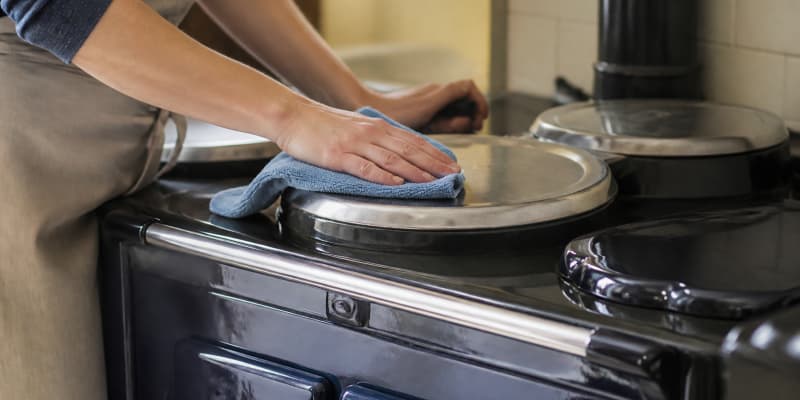
Getting how to clean Aga hotplates right is the difference between chrome lids that gleam for decades and lids that pit and dull within a year. The hotplates themselves need a very different technique to the enamel-topped covers above them, and mixing up the two is the fastest way to shorten the life of both. This guide walks you through the safe method for boiling plate, simmering plate, chrome lids and enamel lids, plus the products worth having in the cupboard and the ones to keep well away.
Quick answer
Clean Aga hotplates dry with the supplied wire brush while warm, never wet. Clean the chrome or enamel lids with a soft cloth and vitreous enamel polish (or Aga stove polish) once the Aga is at slumber temperature and the lids feel just warm to touch. Never apply water to a hot cast-iron hotplate; the thermal shock can crack the casting.
Understanding the two surfaces
The hotplates are cast iron kept hot enough to sear steak. The lids above them are either bright chrome or vitreous enamel over cast iron, insulated to protect the cast surface below. Water on a hot hotplate causes thermal shock and can crack the cast; polish on a hot lid can burn on. Timing is everything.
Older two-oven Agas usually have chrome lids as standard, while newer three and four-oven and electric Total Control Agas have moved to enamel-clad lids in matching cooker colours. Both materials look magnificent when clean and both are ruined quickly by the wrong cloth.
Read also: Aga cleaning checklist for weekly and yearly care
Tools you’ll need
- The wire brush supplied with the Aga (or a replacement from the Aga shop).
- Kitchen roll for wiping brushed residue.
- Aga stove polish or vitreous enamel polish.
- Two soft microfibre cloths (never share with sink or floor cloths).
- A metal spatula, thin and flexible, for lifting stubborn plate residue.
- Bicarbonate of soda for the enamel lids.
How to clean Aga hotplates safely
Boiling plate
- Wait until the plate is warm rather than fiercely hot.
- Brush firmly with the wire brush from the centre outwards.
- Wipe brushed residue away with a dry paper towel.
- Never apply water, oil, or degreaser to the cast surface.
- Close the lid straight away to preserve stored heat.
Simmering plate
The simmering plate is used for direct-cook toast, pancakes and eggs, so it collects more residue. Use the same wire brush and finish with a wipe of dry kitchen roll. Baked-on residue near the edge can be lifted with a metal spatula while the plate is warm; keep the spatula flat to avoid scratching. If a starchy pancake mix has bonded to the plate, brush firmly rather than resorting to water; brief patience beats permanent damage.
Cleaning the chrome hotplate lids
Chrome lids sit above the plates and pick up steam and airborne grease from the whole kitchen. Once a week, when the lids are down and just warm:
- Wipe with a soft damp cloth to remove loose grease.
- Apply a small blob of vitreous enamel or chrome polish (Aga stove polish is ideal) to a microfibre.
- Buff in small circles until the haze disappears.
- Finish with a dry cloth to leave a mirror shine.
- Never use scouring pads, wire wool or bleach on chrome.
Read also: Remove stains from Aga enamel
Cleaning enamel hotplate covers
Enamel lids are easier to look after but chip if knocked with a heavy pan. Clean with warm soapy water and a soft sponge; for stubborn marks, apply a paste of bicarbonate of soda and water, leave 10 minutes, then wipe. Rinse with a clean cloth and dry to prevent watermarks.
Avoid citrus-based sprays and cream cleaners containing bleach; both dull the enamel over time. If a small chip appears, treat it with an enamel touch-up pen matched to your cooker colour to prevent rust starting at the exposed cast.
How often to clean each surface
- Boiling and simmering plates: brush after every use, thorough clean weekly.
- Chrome lids: wipe daily, polish weekly.
- Enamel lids: wipe daily, deep clean monthly.
- Rubber lid buffers: check monthly and replace if perished.
Common mistakes to avoid
- Pouring cold water over a hot hotplate to “clean” it. Cracks are permanent.
- Using oven-cleaner spray on chrome lids. It strips the plating.
- Leaving a wet cloth on the lids overnight, which causes rust rings on the cast below.
- Applying polish while the lid is hot; it bakes on and ghosts the surface.
- Using the same cloth on chrome and enamel; grit transfers and scratches chrome.
When to call in a specialist
If your chrome lids are heavily pitted or your hotplates are heavily coated in carbon that will not brush off, a professional deep clean will get further than home methods. Our engineers use dip tanks and cutting compounds specifically for Aga finishes. Deep pitting on chrome cannot always be reversed, but a specialist can often blend the finish so it looks even and buff out surface haze completely.
Restoring vintage or inherited Agas
Older Agas from the 1970s or 1980s often come with heavily discoloured hotplate covers and lids from decades of use. A restoration clean can bring these back significantly, though very deep pitting may need a chrome re-plating specialist. Send us photos before booking; we can advise whether a standard deep clean will restore the finish or whether specialist re-plating is worth the additional cost.
Conclusion
Aga hotplates and lids reward little-and-often care with the right tool for each surface. When it is time for a full restoration, our Aga cleaning service covers hotplates, lids, enamel front and ovens across London. Check our prices and coverage to plan your next visit.
