
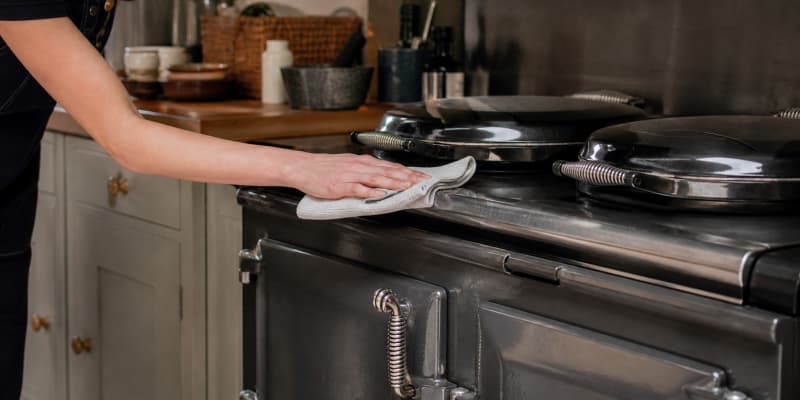
Learning how to clean an Everhot range cooker properly keeps its vitreous enamel gleaming for decades. As an electric heat-storage cooker built in Devon, it needs a slightly different routine to an Aga or Rayburn, and the wrong products can dull the finish for good. Everhot owners often tell us they inherited their cleaning routine from an Aga-owning friend, only to find their enamel has gone matte within a year. This guide brings you the right method, the right products and the exceptions worth knowing.
Quick answer
To clean an Everhot cooker, wipe the warm (not hot) enamel with a soft cloth and hot soapy water after every use, buff dry with a microfibre, and never use scouring pads, wire wool or ammonia-based cleaners on the enamel surface. For stubborn marks, use a bicarbonate-of-soda paste on cool enamel and rinse thoroughly. Book a professional deep clean every 12 to 18 months.
Everhot vs Aga: why cleaning differs
Everhot cookers are fully electric with a thermostat you can turn down or off, so unlike an always-on Aga you can cool the cooker completely for a deep clean. The vitreous enamel is similar, but Everhot’s insulation runs cooler on the outside, which means grease sets less aggressively. This makes daily maintenance easier if you stay on top of it. It also means you have no excuse for burnt-on splashes; if you catch a spill within a shift or two, it wipes away with soapy water.
Another practical difference is size. Most Everhot models come in 60, 90, 100, 110 or 150 cm widths, and the larger models have three or four ovens. Plan your cleaning session around whichever oven is currently coolest, and rotate through them over a fortnight rather than trying to tackle everything at once.
Read also: Aga vs Everhot vs Rayburn: maintenance compared
Tools you’ll need
- Two or three microfibre cloths, colour coded for hob, enamel and glass.
- A soft cellulose sponge with a non-scratch scrubby side.
- Washing-up liquid (Fairy or similar) and a bowl of hot water.
- Bicarbonate of soda for stubborn marks.
- Bar Keepers Friend for grey pan-transfer streaks (used sparingly).
- Aga stove polish or a vitreous enamel polish for chrome and towel rail.
- The supplied wire brush for the cast-iron hotplates only.
Daily and weekly Everhot cleaning routine
After every use
- Wipe the top plate with a damp cloth while it is still just warm.
- Lift the insulated lids and wipe the underside if any splashes reached them.
- Buff dry with a clean microfibre to prevent watermarks on the enamel.
- Wipe the door glass and control knobs with a cloth wrung out in soapy water.
Weekly polish
- Turn the thermostat down and let the cooker drop to hand-warm.
- Wash the enamel with warm soapy water and a soft sponge.
- For light stains, apply a paste of bicarbonate of soda and water, leave 10 minutes, then wipe.
- Rinse with a clean damp cloth and polish with a microfibre.
- Finish the chrome towel rail with a small amount of stove polish and buff.
Deep-cleaning the oven cavities
Everhot oven interiors have a smooth enamel lining rather than catalytic liners. Once the cooker is fully cool, remove the shelves and rails, and soak them in a sink of hot water with a biological washing-up liquid or a scoop of soda crystals for two hours. Inside the cavity, work with a non-abrasive cream cleaner such as Bar Keepers Friend on a damp cloth, avoiding the door seal.
Carbon that has baked onto the roof of the oven softens if you leave a damp cloth over it for an hour before wiping. Never use an oven-cleaner spray marketed for standard ovens; the caustic soda content in products like Mr Muscle or Oven Pride will etch Everhot enamel and leave a permanent chalky patch. If in doubt, contact Everhot for their approved cleaner list.
Read also: Aga cleaning checklist for weekly and yearly care
Hotplates, doors and the flue outlet
Cast-iron hotplates
Everhot’s cast-iron hotplates are hard-wearing but should never be washed with detergent. Brush them with the supplied wire brush when cool, then wipe with a dry cloth. Any pooled fat can be lifted with kitchen roll while the plate is warm. Do not use olive oil to “season” the hotplate; on an electric heat-storage cooker this smokes and stains the enamel around the plate.
Door glass and handles
Use a household glass cleaner sprayed onto the cloth, not the door. This stops overspray running into the door hinge. Chrome handles polish up beautifully with a light rub of vitreous enamel polish. For heavier baked-on marks on the inner glass, cool the oven, apply bicarbonate paste, leave for 30 minutes and wipe with a damp cloth.
Common mistakes to avoid
- Using lemon juice or white vinegar on the enamel; both are acidic enough to etch the finish.
- Reaching for a melamine “magic eraser”; the fine abrasive dulls the shine.
- Applying polish while the enamel is still warm; it bakes on and leaves a hazy ghost.
- Leaving damp cloths on the hotplate lids overnight, which causes rust rings.
- Assuming an Aga-safe product is also Everhot-safe without checking the label.
When to book a professional Everhot clean
Every 12 to 18 months, book a specialist to strip, dip and refit shelves, clean the ovens back to enamel white, and check the door seals for compression. If you have used the wrong product and dulled the enamel, a professional can often restore the finish with cutting compound rather than replacing panels. In hard-water postcodes across London, we also see mineral scale build up on the underside of the insulated lids; a specialist clean lifts this without scratching.
Conclusion
An Everhot rewards a steady weekly routine and a firm no to harsh chemicals. When you need the enamel bringing back to showroom condition, our team at Aga and range cooker cleaning handle Everhot, Aga and Rayburn cookers across London with the correct products and equipment. See our coverage areas to check availability in your postcode.
