
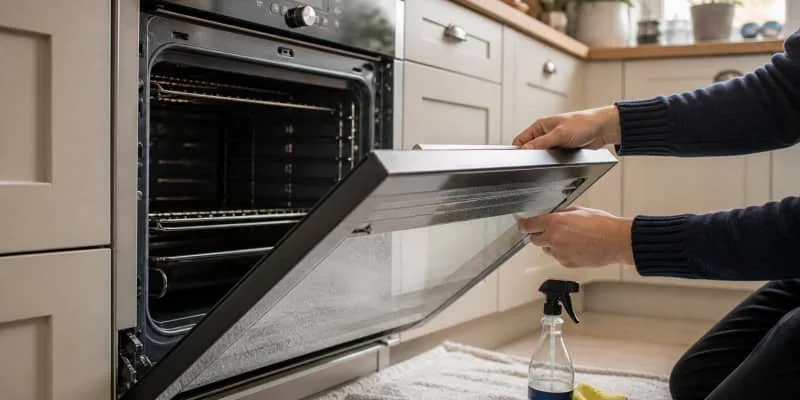
Hotpoint ovens are among the most common built-in models in UK kitchens — reliable, affordable, and often specified into new-build developer kitchens across London and the South East. Most people never realise their door glass lifts out entirely for cleaning, which is why so many perfectly functional Hotpoint ovens look tired long before they should. Learning how to clean a Hotpoint oven — including the door strip-down that lets you clean between the panes — brings back that fresh-from-the-shop finish and adds years to the appliance. It also transforms tenancy inspections, where a grubby oven is a landlord’s most common deduction reason.
Quick answer
To clean a Hotpoint oven, run the pyrolytic cycle if fitted (remove all shelves and rails first). For non-pyrolytic models, apply a bicarbonate-of-soda paste to the interior overnight, then wipe away with a damp microfibre. Lift the door off using the hinge locks, slide the top trim to release the inner glass pane, wipe each pane with paste, rinse and refit. Never spray oven cleaner into the fan cover or onto the door hinges.
Identifying your Hotpoint
- Pyrolytic — has a self-cleaning menu; door lock icon on display
- Catalytic — has textured rear panels that self-oxidise
- Standard — smooth enamel throughout, needs manual cleaning
- Multi-flow (fan-assisted) — most common in UK new builds; usually standard enamel
The model number sticker inside the door frame lists the features. Hotpoint model numbers typically begin with SA, SI or FA depending on the range.
Pyrolytic cycle
- Remove all shelves, side rails and pizza stones.
- Wipe out large debris and drain any pooled fat.
- Close the door and select Self Clean or Pyrolytic from the menu.
- Choose duration — light (75 min) or heavy (2h30).
- The door locks automatically until the cavity cools.
- When cool, wipe out the ash with a damp cloth.
- Wash the shelves separately in hot soapy water.
Read also: How to clean a Zanussi oven
Manual cleaning
- Cool completely.
- Remove shelves and side rails.
- Mix six tablespoons of bicarbonate of soda with warm water into a spreadable paste.
- Apply to interior, avoiding fan cover and top element.
- Leave overnight (at least 12 hours).
- Wipe out with a damp microfibre.
- Spray persistent spots with white vinegar to help lift.
- Rinse and dry with a tea towel.
Removing the Hotpoint door
Hotpoint door hinges use small flip-out locking tabs.
- Open the door fully.
- Flip each hinge lock outward — you will see a small metal tab.
- Partly close the door until it stops at the hinge locks.
- Lift the door upward and away from the hinges — support the weight with both hands.
- Lay flat on a folded towel on a table or worktop.
Read also: How to clean a Samsung oven
Cleaning between the glass panes
Slide the metal trim at the top of the door away from the hinges — the inner pane slides out. Wipe both panes with bicarbonate paste applied on a soft cloth, leave for thirty minutes, then rinse and dry. Slide the panes back into their slots in the correct order — check for arrows or markings that indicate orientation. Refit the trim and clip the door back into the hinges, then press the hinge locks back to their original position. If the door does not seat correctly, do not force it; open fully, adjust the hinge angle and try again.
Read also: Clean oven door hinges and seals
Shelves and racks
- Soak in hot water with two dishwasher tablets for two hours
- Scrub with a nylon brush after soaking — the residue should slide off
- Dry immediately with a tea towel to prevent rust
- For very tired shelves, Hotpoint spares sell replacements for ten to fifteen pounds
Fan cover and element
Never scrub the fan cover with wire wool. Wipe with a soft cloth dipped in a mild soapy solution, and remove any pieces of food that have lodged in the fan grill. Do not attempt to remove the fan cover unless you are confident with electrical appliances — it is held by concealed screws behind the rear enamel and is a service technician’s job on most Hotpoint models.
Cleaning the seal and hinges
The rubber door seal on a Hotpoint takes food splatters and grease during every cook. Wipe with a soft damp cloth and warm soapy water — never bleach, which perishes the rubber. Pull the seal back gently along each edge and clean underneath with a cotton bud; food dust here is the most common cause of poor door closure. Check the hinge springs by opening and closing the door slowly; a hinge that catches or squeaks may just need a wipe with a barely-damp cloth, but a broken hinge spring needs replacement.
Keeping it clean
- Wipe spills while the oven is still warm
- Place a reusable oven mat on the base for roasts (never on the fan cover)
- Line grill pans with foil to catch splashes
- Do a light bicarbonate wipe once a month
- Cover roasting tins with a lid or foil to reduce splatter
Common mistakes
Do not use foil on the base of a fan oven — it reflects heat back at the element. Do not spray oven cleaner into the seal groove — the caustic degrades the rubber. Do not attempt to lift the door without flipping both hinge locks out first — you can spring the hinge and require an expensive repair. And do not forget to refit the inner glass in the correct orientation; a reversed pane pops out on first use.
Conclusion
A door strip-down is the single job that transforms a Hotpoint oven from tired to like-new — most owners have never done it and are amazed by the result. Bicarbonate paste for the interior, hot soak for the shelves, glass-pane strip-down for the door. For an annual professional deep clean including door glass and racks, book a visit at Maggie’s oven cleaning in London.
