
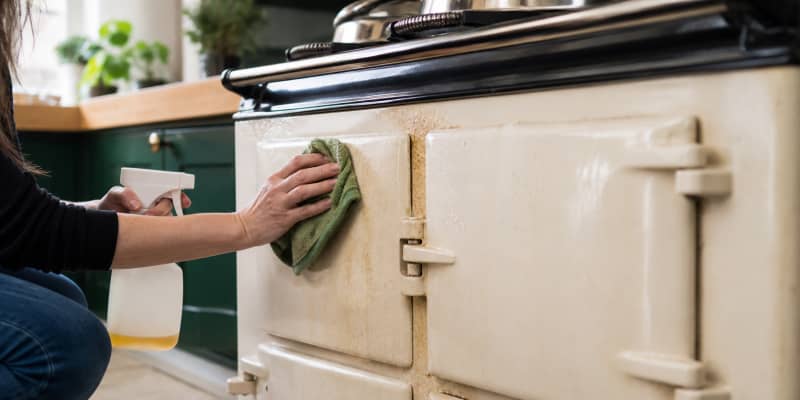
Learning how to remove stains from Aga enamel without damaging the glossy finish takes patience and the right products. Vitreous enamel is a glass-fused-to-cast-iron coating; it is tough but reacts badly to acids and abrasives. Once you know how to identify the stain and pick the right technique, most marks lift within half an hour, leaving the surface as good as new. Get impatient with the wrong product and you can dull decades of glossy finish in seconds.
Quick answer
To remove stains from Aga enamel, cool the cooker to hand-warm, apply a paste of bicarbonate of soda and water, leave for 15-30 minutes, then wipe gently with a microfibre. Avoid lemon juice, vinegar, bleach and scourers. For stubborn pan-metal transfer, use a small amount of Bar Keepers Friend on a damp cloth and rub in one direction only.
Identify the stain first
Different stains need different treatments. A quick rule of thumb:
- Yellow or brown grease shadows: a mild alkaline paste like bicarbonate of soda.
- Water marks and limescale rings: a soft cloth with distilled water first, then enamel polish.
- Metal scrapes from pan bases: a mild cream cleaner like Bar Keepers Friend, worked gently.
- Burned-on sugar or jam: soften with a damp cloth over the mark for an hour before wiping.
- Dark patches around the door hinge: usually baked-on grease, treat as grease shadow.
Read also: Aga cleaning checklist for weekly and yearly care
Tools you’ll need
- Bicarbonate of soda (a full tub, not a small sachet).
- A small mixing bowl and plastic spatula.
- Bar Keepers Friend (original powder, not the cream with bleach).
- Two microfibre cloths and a soft cellulose sponge.
- Distilled water for limescale rings.
- Aga stove polish for the final buff.
Step-by-step: bicarbonate paste method
This is the workhorse method that handles most everyday grease shadows.
- Slumber the Aga so the enamel is only warm to touch.
- Mix three tablespoons of bicarbonate of soda with one tablespoon of water into a thick paste.
- Apply the paste to the stain with a plastic spatula, not a metal knife.
- Leave for 15 to 30 minutes; the alkaline paste lifts the grease chemically.
- Wipe off with a damp microfibre, rinse the cloth and repeat until the enamel comes clean.
- Buff dry with a second microfibre to reveal the true finish.
- Finish with a light layer of Aga stove polish to protect the surface.
Tackling metal scrapes and pan marks
Grey streaks near the boiling plate are usually aluminium transfer from pan bases. They look like scratches but they are actually raised deposits sitting on top of the enamel.
Sprinkle a very small amount of Bar Keepers Friend onto a damp microfibre and rub the streak in one direction with light pressure. Rinse the area and dry. Never use a scouring pad, wire wool or Cif Cream containing bleach. Test a small hidden area first if you are unsure of the enamel condition, especially on older heritage-colour Agas where the enamel may have thinned over decades.
Read also: Aga cleaning: what NOT to use and why
Removing burnt-on food and sugar
Boil-over from jam or milk pans is a common problem. Rather than scraping while still warm and risking a scratch, lay a hot damp cloth over the mark and leave for an hour. The residue rehydrates and lifts with a plastic spatula. Follow up with the bicarbonate paste to remove any shadow, and finish with a polish.
What NOT to use on Aga enamel
- Lemon juice or vinegar: acids etch the enamel and leave a permanent dull patch.
- Oven-cleaner sprays: caustic soda content burns the enamel.
- Wire wool, green scourers or melamine sponges: they micro-scratch the glass surface.
- Bleach-based cream cleaners: they discolour cream and light enamels.
- Steam cleaners aimed directly at chips: they lift more enamel off.
- Astonish Mould & Mildew or other bathroom bleaches: not designed for kitchen enamel.
Frequently asked questions
Can I use Astonish paste on Aga enamel?
The pink Astonish Oven & Cookware paste is safe on cool enamel used sparingly and rubbed with a soft sponge, not a scourer. Test a hidden area first.
Will bicarbonate scratch the finish?
No, if mixed to a paste with water. Bicarbonate is mildly abrasive but softer than the enamel; it will not scratch when kept wet.
How do I remove a stain around a chip?
Clean gently around the chip, then treat the chip with an Aga touch-up pen before more grease penetrates the exposed cast iron.
When professional help is worth it
Deep-set brown discoloration around the burner or roasting oven door often needs a professional buff with cutting compound. Chips down to the cast can be treated with enamel touch-up kits, but the colour match is challenging on cream, black and heritage red. A specialist can also blend polish across the whole panel so the repaired area does not stand out.
Preventing stains in the first place
The best stain-removal strategy is prevention. Wipe up spills before they bake on, use a splash guard behind pans when boiling milk or making jam, and never leave wet cloths draped over the enamel. In hard-water London postcodes, dry the enamel with a microfibre after every wipe to prevent limescale rings appearing on cream or ivory finishes. A twice-yearly application of Aga stove polish adds a thin protective layer that makes future stain removal much easier.
Conclusion
Most Aga enamel stains lift with patience, bicarb and a soft cloth if you catch them early. For heavy discoloration or chips, our Aga cleaning service restores the finish using techniques and products that home users cannot easily buy. See our coverage areas across London for availability.
