
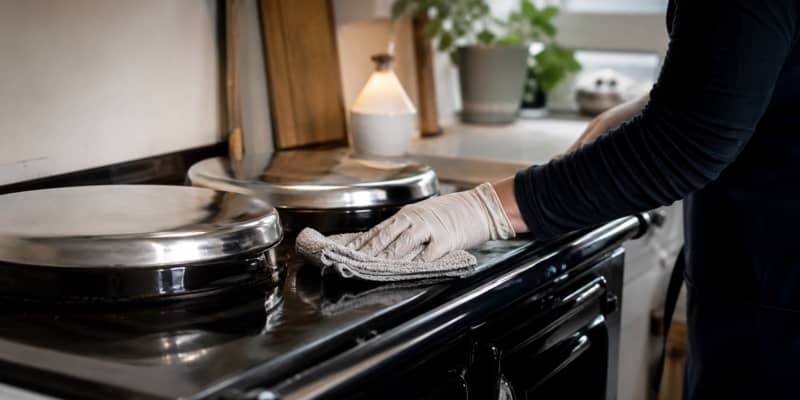
Knowing about Aga cleaning what not to use is at least as important as knowing what to use. The wrong product can etch enamel, strip chrome or attack door seals in minutes, and no cleaner will bring the finish back. We see the results in customer kitchens almost every week: a beautiful heritage-blue two-oven Aga with a matte patch across the front, or a cream three-oven with hazy chrome lids, all caused by a single wrong choice at the shelf.
Quick answer
Never use caustic oven-cleaner sprays, lemon juice, vinegar, bleach, wire wool, melamine “magic” sponges or ammonia-based glass cleaners on an Aga. All of them damage vitreous enamel, chrome or door seals. Stick to warm soapy water, bicarbonate paste for stains, and Aga stove polish for chrome and lids.
Why Aga cleaning products are so specific
Aga cookers are finished in vitreous enamel, which is glass fused to cast iron at very high temperature. That gives you a durable, glossy surface but also a chemically sensitive one. Acids attack the glass matrix; caustic alkalis at high strength dissolve it; abrasives micro-scratch it and dull the shine forever.
Add chrome hotplate lids, painted flue trims and rubber door seals and you have four different materials on one appliance, each with its own vulnerabilities. A cleaner that is fine on one surface will attack another, so the safest habit is to keep the product list short and only stray from it when you know exactly what you are doing.
Read also: Aga cleaning checklist for weekly and yearly care
Products to keep away from your Aga
Caustic oven cleaners
Any spray whose label warns you to wear gloves and eye protection almost certainly contains sodium hydroxide (caustic soda). Brands to keep well away include Mr Muscle Oven Cleaner, Oven Pride, Oven Brite and the caustic gel Ovenmate produce. On standard oven enamel these are fine at short contact times, but on Aga vitreous enamel they will pit the surface and turn a glossy cream front into a matte, chalky patch.
Acidic natural cleaners
Lemon juice and white vinegar are popular household cleaners, but they should never touch Aga enamel. Both are acidic enough to etch the finish, especially if left on warm enamel for more than a few minutes. Cream of tartar, descaler products and Viakal fall into the same category. If you must descale a nearby kettle, do it away from the Aga so drips do not reach the enamel.
Wire wool and green scourers
Abrasive pads leave micro-scratches that dull the shine. Once you see a matte patch on a glossy Aga panel, it does not polish out with home methods. Even the “non-scratch” side of a standard washing-up sponge is too aggressive for delicate high-gloss enamel; use a soft cellulose sponge or microfibre instead.
Melamine “magic” erasers
Melamine foam works by acting as an extremely fine abrasive. On Aga enamel it removes the shine along with the stain, leaving a slightly cloudy patch that looks worse than the original mark.
Ammonia glass sprays
Many household glass cleaners contain ammonia which dulls chrome and softens rubber door seals if overspray reaches them. Spray glass cleaner onto the cloth first, never straight onto the cooker.
Read also: Remove stains from Aga enamel
Products to use with caution
Some products can be used carefully but easily cause damage when used wrong.
- Bar Keepers Friend: mild abrasive, safe if diluted on a damp cloth and used sparingly.
- Bicarbonate of soda paste: safe on enamel, but never rub aggressively.
- Household glass sprays: safe on the oven door glass, but never on chrome lids or enamel.
- Steam cleaners: safe on soft grease, but never aimed at chips or seals.
- Astonish Oven & Cookware paste: safe on cool enamel with a soft sponge, avoid on chrome.
What to use instead
- Warm soapy water with washing-up liquid for daily wipes.
- Aga-approved enamel cleaner for weekly polishing.
- Aga stove polish for chrome lids and towel rail.
- Bicarbonate of soda paste for stubborn stains on enamel only.
- Wire brush (supplied with the Aga) for hotplates only.
- Bar Keepers Friend, sparingly, for pan-metal transfer streaks.
Read also: Are oven-cleaner sprays toxic?
Watch out for well-meaning advice online
There are dozens of viral cleaning hacks that recommend baking-soda-plus-vinegar mixes, lemon halves for scorch marks or steam cleaners for anything. They may be fine on standard ovens but they cause real, sometimes irreversible damage on an Aga. If a technique is not published by Aga itself, ask a specialist before applying it to a five-figure appliance.
What to do if you have already used the wrong product
If you have used a caustic spray or acidic cleaner, rinse the surface immediately with copious warm water and dry with a microfibre. Do not scrub. Book a specialist to assess the damage as soon as possible; light dulling can often be buffed out with a cutting compound within a day of exposure, while damage left for months tends to be permanent. Heavier damage sometimes needs enamel re-firing at the factory, which is rarely economic.
Conclusion
The list of what not to use on an Aga is longer than the list of what you can. When you want the peace of mind of the right products used the right way, book our Aga cleaning service for a professional deep clean. See our prices for a full Aga service in London.
