
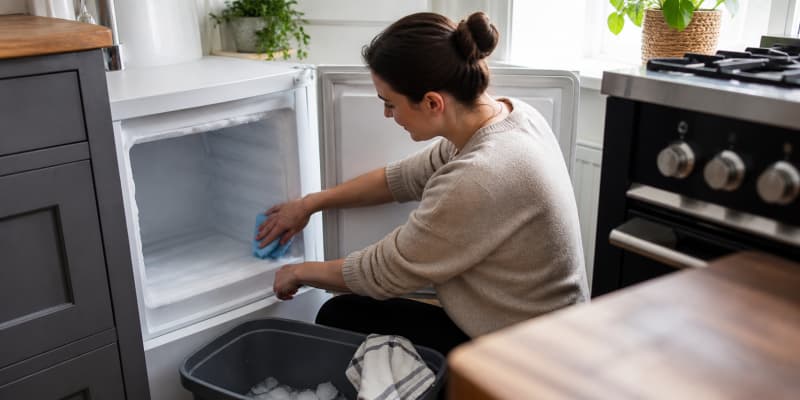
Ice thicker than a five-pence coin costs you real money in wasted electricity, and the longer you leave it the messier the eventual defrost becomes. What starts as a light frost on the walls turns into a thick, uneven mass that eats into shelf space and makes the compressor run twice as long to hold temperature. Here is how to defrost a freezer quickly, catch every drip, and get it back in service in a few hours rather than a full day — and how to keep it defrost-free for longer next time.
Quick answer
To defrost a freezer, switch it off at the wall, empty it into a cool bag with ice packs, and line the base with old towels topped by a shallow baking tray. Place two heat-proof bowls of hot (not boiling) water inside and shut the door for 20 minutes at a time. Wipe out melted water as it forms and repeat until ice slides off. Wipe out with bicarbonate solution and dry before switching back on. Never chip ice with a knife.
Plan the timing
Aim for a day when your freezer is close to empty — the day before a big shop is ideal. A modest 100-litre freezer with a centimetre of ice takes 1–2 hours; a chest freezer with 3 cm of build-up can take 4–6 hours; American-style side-by-side units with an ice maker can take a whole day. If you cannot commit the time, work in stages and use a cool bag with ice packs to hold food for up to eight hours. Winter is ideal in the UK — an open kitchen door helps cool the temporary storage.
What you will need
- Two large cool bags with ice packs — bigger than you think you need
- Old towels and a shallow baking tray
- Two heat-proof bowls of hot tap water
- Plastic scraper — never a knife or metal spatula
- Microfibre cloths and a bucket
- Bicarbonate of soda for the after-clean
- A wooden spoon to loosen ice sheets safely
Step-by-step defrosting
- Turn the freezer off at the wall and prop the door open. If it is an integrated unit, place a wooden spoon in the doorway to keep it ajar.
- Move all food to cool bags with ice packs. Group items so they stay cold longer.
- Line the freezer base with towels and lay a baking tray at the front edge to catch drips.
- Place two bowls of hot water on the top shelf and close the door for 20 minutes.
- Open, refresh the water, gently scrape loose sheets of ice with a plastic scraper.
- Repeat until the ice is gone — usually two to four cycles.
- Wipe out with a bicarbonate-of-soda solution (one tablespoon per 500 ml).
- Dry thoroughly, switch the freezer on and wait 30 minutes before refilling.
Read also: How to clean a fridge and freezer properly
Quick defrost tricks
Some people swear by a fan on low blowing warm air into the compartment — this can halve defrosting time in a chest freezer. A steam cleaner held 30 cm away speeds up melting without scratching the plastic. Do not use a hair dryer close to plastic panels; the heat will warp them and can burn the powder coating around the shelves. Placing a small saucepan of hot water on a folded towel on the middle shelf, with the door shut, does most of the work while you get on with something else.
Read also: Remove fridge odours naturally
What not to do
- Do not chip at ice with a knife, screwdriver or metal scraper — the coolant lines run just behind the plastic
- Do not use salt to melt ice, as it corrodes metal components
- Do not pour boiling water in — the plastic can warp and the sudden thaw shocks the shelves
- Do not leave the door shut with no power for more than a few hours — you will grow mould
- Do not restock while any surface is wet — new ice starts to form immediately
Refilling and preventing future build-up
- Wait until the freezer reaches −18 °C before refilling — check with a fridge thermometer
- Cover food in airtight bags to reduce moisture release
- Check the door seal — replace if it no longer grips a sheet of paper
- Avoid overfilling; airflow keeps ice from forming
- Defrost annually, or when ice reaches 5 mm
- Open the door as briefly as possible — every open cycle draws in warm humid air
Do frost-free freezers still need defrosting?
Officially no, but in practice yes — every one or two years. Frost-free models use a heating element to melt ice periodically, but if the drain hole at the back blocks with debris, ice builds up on the fan and shelves anyway. A full manual defrost clears any blockage and gives the fan back its full airflow. If your frost-free freezer feels louder than a year ago, that is your cue.
Read also: How to clean a washing machine drum and drawer
Conclusion
A properly defrosted freezer runs quieter, costs less to run and holds a proper minus-eighteen. Book an afternoon once a year, follow the eight-step method above, and you will never end up with the classic thick-frost horror show. If you would rather hand the whole job — freezer, fridge, oven and hob — to someone else, book a professional at Maggie’s appliances cleaning in London.
