
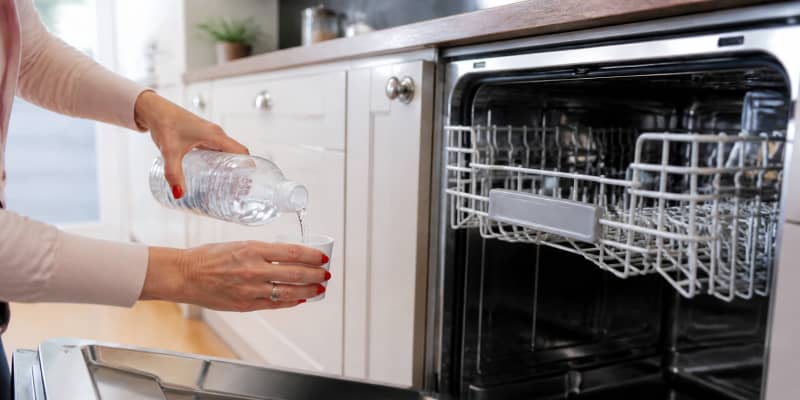
A dishwasher that leaves gritty glasses or a musty smell is not broken — it is dirty. Grease from plates, bits of rice from that Wednesday-night curry and calcium from London’s famously hard tap water build up in exactly the places that stop the machine cleaning properly. Learning how to clean a dishwasher with vinegar, in the right order, restores wash performance, clears the limescale that stops rinse aid working, and adds years to the pump and heater. It takes forty minutes of your time and around three pounds of ingredients.
Quick answer
To clean a dishwasher, empty it fully, remove and rinse the filter under a hot tap, wipe the rubber door seal with a vinegar-damp cloth, then place a dishwasher-safe bowl of 250 ml white vinegar on the top rack and run the hottest empty cycle (usually Intensive or Auto 70). When it finishes, sprinkle a handful of bicarbonate of soda across the base and run a short 30-minute cycle to rinse and deodorise. Deep clean every three months.
Why vinegar works
White vinegar is a mild acid (acetic acid at around 5%), which dissolves the limescale, soap scum and mineral deposits that build up on spray arms and heating elements. It also breaks down fatty residues and neutralises odours. It is safe on stainless steel drums and rubber seals when used a few times a year — but do not use it every week or it can degrade the seals over time. Citric acid in solution does the same job with no smell; a tablespoon dissolved in the same amount of water works just as well for anyone who dislikes the vinegar aroma.
Read also: How to clean a washing machine
What you need
- 500 ml distilled white vinegar (or two tablespoons of citric acid dissolved in water)
- Bicarbonate of soda
- Old toothbrush and microfibre cloths
- A heatproof dishwasher-safe bowl or mug
- Torch for inspecting spray arms
- Cocktail stick or wooden skewer for blocked jets
- Rubber gloves — old dishwasher water is not pleasant
Step-by-step dishwasher clean
- Empty the machine and pull out the bottom rack.
- Twist the filter counter-clockwise, lift it out and rinse under a hot tap. Use an old toothbrush to clear food from the mesh — expect surprising quantities.
- Wipe the door seal — top, sides and inner lip — with a vinegar-damp cloth. Black mould loves this fold.
- Check the spray-arm holes with a torch. Poke blocked jets with a cocktail stick.
- Place 250 ml of white vinegar in a heatproof bowl on the top rack.
- Run the hottest programme with no detergent (Intensive 70 or equivalent).
- When finished, scatter a handful of bicarbonate of soda across the base.
- Run a short 30-minute cycle to rinse and deodorise.
- Leave the door ajar overnight so the drum dries fully.
Read also: How to descale a coffee machine
Fixing specific problems
Cloudy glasses
Usually means either hard-water etching (permanent) or the salt reservoir is empty. Top up the dishwasher salt and set the water hardness on the control panel to match your area — London and the South East are hard-water zones, so set the machine to level five or six. Rinse aid should also be topped up: an empty rinse-aid dispenser is the second most common cause of cloudy glassware.
Bad smell
Nine times out of ten it is trapped food in the filter or the plinth drain. Clean both, then run a vinegar cycle. If the smell returns within a fortnight, check the drain hose for a low sag holding stagnant water.
Standing water in the base
Check the drain hose for a kink behind the machine and clear the sump filter. If the water still will not clear, the drain pump filter (behind the plinth, similar to a washing machine) may need clearing.
Dishes not drying
Rinse aid empty, or the salt level is low. On Bosch and Neff, hold the rinse-aid button to adjust dosage — level four is right for hard-water areas.
London hard-water tips
Hard-water areas need dishwasher salt in addition to detergent tablets, even if you use “all-in-one” tablets that claim to include salt and rinse aid. Top up the salt tank every four weeks and set the hardness dial to the highest level your machine allows. Use Finish Quantum tablets or Fairy Platinum Plus for the best results in London water; cheaper tablets simply do not have enough sequestrant to hold the calcium in solution.
Loading tips for a cleaner wash
Even a spotless dishwasher cleans poorly if loaded badly. Face plates towards the spray arms. Keep tall glasses and utensils away from the arm’s rotation arc. Never stack bowls inside each other; the top one blocks water reaching the bottom. Pre-rinse only very heavily soiled dishes — modern detergents need something for the enzymes to bind to, so scraping is enough. In flats where the dishwasher runs only every two or three days, add a spoon of soda crystals to the empty base between full cycles to keep smells at bay.
Read also: How to descale a kettle
How often to clean
- Filter: rinse weekly
- Seal and spray arms: wipe monthly
- Vinegar deep clean: every three months
- Commercial dishwashers: daily filter clean, weekly descaler cycle
- Salt and rinse aid: top up monthly in hard-water areas
Read also: Small kitchen appliance cleaning checklist
Conclusion
A vinegar cycle every three months keeps dishes sparkling and stops the machine smelling of last week’s dinner. Filter weekly, seal monthly, deep clean quarterly — that is the whole routine. If you would rather hand the whole kitchen — dishwasher, oven, extractor — to a professional, book a visit through Maggie’s appliances cleaning in London.
