
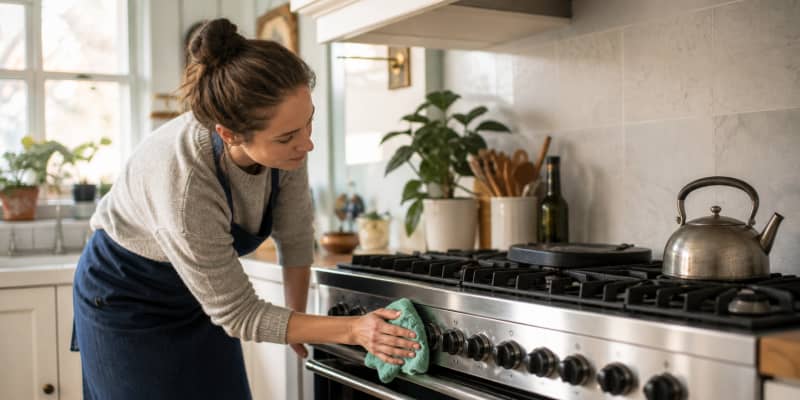
A good buying a range cooker guide should stop you making the ten mistakes we see when we visit customers a year after installation. Range cookers are big-ticket appliances and small oversights become long-term regrets. Whether you are looking at a Rangemaster, Falcon, Britannia, Bertazzoni, Smeg, Belling or Everhot, the ten checks below matter more than any brochure promise. Skip them and you can spend 2,000-5,000 GBP on a cooker that never fits your space or your cooking style.
Quick answer
Before buying a range cooker, check width against your kitchen slot, fuel supply (gas or dedicated 32 A electric), oven capacity split, hob configuration, cleaning finish (steel or enamel), warranty length and parts supply, plus installation and running costs. Involve a Gas Safe engineer and a qualified electrician before you place the order.
1. Width and floor space
Range cookers come in 90 cm, 100 cm, 110 cm and 120 cm widths. Measure the aperture between cabinets and remember gas cookers need side clearance to combustible materials (typically 25 mm). Add depth: some models like the Falcon Continental and LaCornue CornuFe are deeper than the standard 60 cm counter, so the door will protrude.
2. Fuel supply
Dual fuel (gas hob, electric ovens) is the most popular choice. All-electric is easier to install but needs a heavy circuit. All-gas is now rare and requires strong ventilation.
- Dual fuel: gas point plus 32 A electric supply.
- All-electric: dedicated 32 A on some models, some now need 45 A.
- All-gas: high input rating; check your gas meter capacity.
- Induction dual fuel: increasingly popular; needs 32-45 A supply.
Read also: Aga vs Everhot vs Rayburn: maintenance compared
3. Number of ovens
A 90 cm cooker usually gives you one main oven plus a grill cavity. A 100 cm cooker adds a second oven. 110 cm and up may add a third cavity or a warming drawer. Match this to how you actually cook, not the fantasy of hosting 12 for Christmas. If you host large family meals only two or three times a year, a good 90 cm range with a proper wok burner will serve you better than an unused 120 cm.
4. Hob configuration
Ranges are marketed on burner counts, but layout matters more.
- Five or six gas burners with at least one wok burner (rated 3.5 kW+).
- Induction zones with bridging for large pans.
- Ceramic zones for lower cost but slower response.
- Central griddle, wok or teppanyaki module on some models.
- Dedicated simmer burners for stocks and sauces.
5. Cleaning finish
The cleaning burden varies wildly:
- Vitreous enamel front (Aga, Rangemaster Elan): rich colours, no fingerprints, needs enamel polish.
- Stainless steel front (Falcon, Bertazzoni): shows every finger, needs specific polish.
- Matt or coloured stainless (Britannia): hides marks well, quick wipe.
- Painted steel (Smeg Portofino): easy to wipe but shows scratches on darker colours.
Also check whether the ovens are pyrolytic; range cooker pyrolytic cavities are increasingly common on Rangemaster, Falcon and Britannia flagship models.
Read also: How to clean a Rangemaster cooker
6. Warranty and parts
Long warranties look good on the box but the real question is parts availability in year seven. Rangemaster, Falcon, AGA, Britannia and Bertazzoni all have UK spares networks. Cheaper unfamiliar brands may leave you stranded when a fan motor fails. Rangemaster is particularly strong on this front in the UK; parts for models over 15 years old are still readily available.
7. Installation cost
- Dual fuel install: 200-400 GBP through a Gas Safe engineer.
- Electric-only install: 150-300 GBP; may need a new higher-rated circuit.
- Extraction check: hood must extract to outside above a range this size.
- Stability chain fitting: mandatory on all freestanding gas cookers.
Get the electrician or Gas Safe engineer to survey before you order.
Read also: Best ovens to buy in 2026
8. Running costs
Big ovens use more energy than small built-ins. Look for A or A+ ovens and pyrolytic cycles rated at 2-3 kWh. Induction hobs beat gas on efficiency but need a strong supply. Budget an extra 10-15 GBP a month on energy compared with a compact built-in oven and hob if you cook regularly.
9. Weight and delivery
Range cookers commonly weigh 150-250 kg. Check delivery includes into the kitchen, not just kerbside. Confirm the delivery route through doorways and any lifts, and measure staircase widths and turns if you live above ground floor. Some retailers charge extra for stair carries.
10. Try before you buy
Visit a showroom and open doors, pull out shelves, feel knob action. A well-designed range cooker is a pleasure to use; a badly designed one is a daily irritation. Pay attention to how heavy the door feels; a poorly counterweighted door will slam by year three.
Bonus: extraction and ventilation
The hood above a 90 cm+ range needs to move at least 600 m3/h of air, and 800-1000 m3/h for gas ranges over 100 cm. Under Building Regulations Part F, the hood should extract to outside where possible. In flats where external extraction is not permitted, choose a recirculation hood with an active charcoal filter and plan to replace the filter every 6-12 months.
Conclusion
Buying well saves you money and hassle for a decade. When your new cooker is installed, book a first deep clean at 6-12 months to reset the enamel and shelves. Our gas cooker installation service supports range cooker installations across London with fully Gas Safe engineers. See our coverage areas.
