
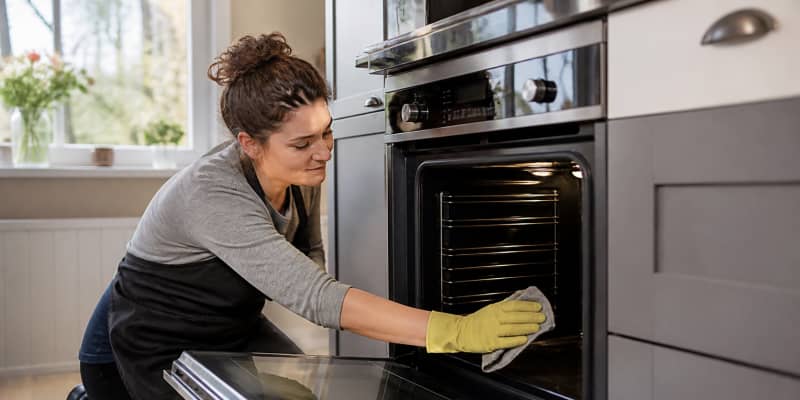
Choosing single vs double oven is one of the trickier kitchen calls, because the right answer depends on how you cook rather than how big your family is. A busy household of two roast-loving foodies gets more from a double than a family of five who mostly heat pizzas. In compact London flats, the choice is also constrained by housing height and the age of the cabinetry, so a shortlist that ignores your existing kitchen layout is a shortlist you will regret.
Quick answer
Choose a single oven if you cook one thing at a time, want maximum internal capacity in one cavity, or have a small kitchen. Choose a double oven if you regularly cook two dishes at different temperatures or want a dedicated grill cavity alongside a main oven. Measure your housing height (typically 60 cm for a single, 72 cm built-under, or 88-90 cm for a tall built-in) before you shop.
What each configuration offers
Single oven
One large cavity, typically 65-75 litres, with a separate grill inside the same space. Available in built-in, built-under and freestanding formats. Ideal for solo cooks and small families who cook one thing at a time.
Double oven built-in (housing 88-90 cm tall)
A larger main oven (usually 65-70 litres) with a smaller grill cavity or second oven above (typically 35-40 litres). The most flexible option for family kitchens; you can grill in the top while roasting in the bottom.
Double oven built-under (housing 72 cm tall)
Two similar-sized cavities designed to fit under a worktop, often 42 litres each. Popular in older kitchens with worktop-height housings. Both cavities are small individually but useful together.
Read also: Best ovens to buy in 2026
Cooking style and family size
Ask yourself two questions:
- Do you often cook two dishes needing different temperatures at once?
- Do you grill and roast at the same time, especially for Sunday lunches?
Two yeses means a double oven will feel liberating. Two nos means a single oven with a decent internal grill is fine.
Double ovens also come into their own when entertaining: you can hold a starter warm in the top cavity while the main course cooks below. Cake-baking families also value the smaller top cavity for consistent temperature at lower ranges.
Kitchen dimensions and layout
Ovens are made for specific housings. Do not assume you can swap a single for a double or vice-versa without cabinet work.
- Built-in single: housing height around 60 cm.
- Built-under double: housing height 72 cm, worktop-height install.
- Built-in double (tall): housing height 88-90 cm.
- Width for all: standard 60 cm.
- Depth: 550-570 mm; newer pyrolytic ovens are often deeper.
If your kitchen already has a tall housing, a built-in double is the natural swap. If you have a worktop-height housing, a built-under double or single are your options.
Read also: How to clean a double oven
Cleaning and running costs
Double ovens cost slightly more to run because you have two cavities to heat, seals to fail and elements to replace over time. Cleaning also doubles: two doors, two sets of shelves, two seals.
That said, dedicating a smaller cavity to daily jobs (chips, grilled cheese, reheating) saves time and energy compared to firing up a large single every night. A pyrolytic top cavity is unusual but does exist on premium doubles.
Read also: How to measure for a built-in oven
Fuel type: gas or electric
Most doubles now sold in the UK are electric. Gas double ovens are still available but fewer models each year, and installation must be by a Gas Safe engineer. If you want gas for one cavity, look at range cookers rather than built-in doubles. Note that in some London new-build blocks, gas is no longer permitted at all under the Future Homes Standard direction, so electric doubles are the default.
Cost comparison
- Single oven: 300-1,500 GBP for domestic models.
- Double oven built-under: 400-1,200 GBP.
- Double oven built-in tall: 600-2,500 GBP.
- Pyrolytic premium (any format): add 200-500 GBP.
Installation is usually 100-250 GBP for a like-for-like electric swap, more if cabinetry needs adjusting.
Common mistakes to avoid
- Ordering a tall built-in double before measuring the housing.
- Assuming the top cavity has a fan; many still use conventional heating only.
- Forgetting that a taller housing eats worktop space.
- Choosing a very small built-under double that struggles with a big roasting tin.
Frequently asked questions
Can two people cook simultaneously in a single oven?
Yes, but only at the same temperature and only if the dishes tolerate mixed odours. A double eliminates both compromises.
Do double ovens use twice the energy?
No; you rarely use both cavities together for long periods. Overall energy use is usually 20-30 per cent higher than a single of similar quality.
Conclusion
The best oven configuration is the one that matches how you actually cook, not how you imagine you might. When you buy, ask us to look at the housing dimensions and finish; a professional deep clean before or after the swap is a common part of our oven cleaning service in London. See our prices for single and double oven deep cleans.
