
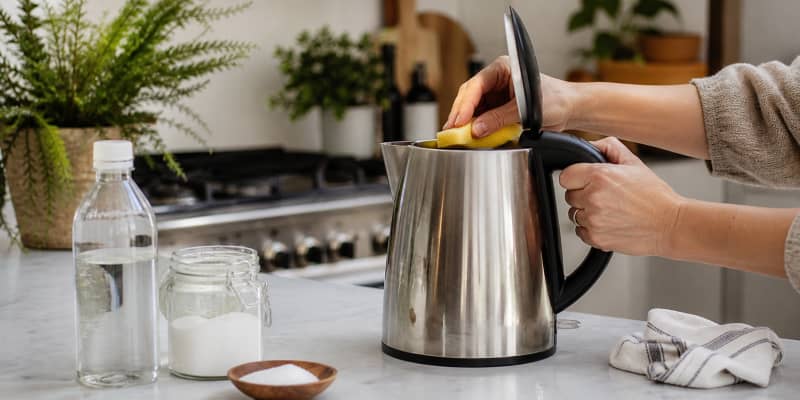
Limescale floating in your morning brew is not just annoying — it is a sign your kettle is working harder than it should, using more electricity, and heading for an early retirement. In London and the South East, a daily-use kettle can pick up a millimetre of scale on the element in eight to ten weeks. Learning how to descale a kettle takes ten minutes, costs pennies, and saves you a new appliance every couple of years. Better still, the water boils faster and tastes cleaner — a win on both the electricity bill and the morning tea.
Quick answer
To descale a kettle, fill it halfway with a 50/50 solution of white vinegar and water, or dissolve two tablespoons of citric acid in a full kettle of water. Boil, then unplug and leave to stand for 30 minutes. Pour away, rinse three times with fresh water and boil a full kettle once more, discarding the water before brewing. Repeat monthly in hard-water areas — the calcium builds up faster than you would think.
Which descaler should you use?
- White vinegar — cheap, effective, smells strong but rinses away easily
- Citric acid — odourless, food-safe and stocked at most supermarkets in the baking aisle
- Store-bought descalers — Oust, Ecozone and Kilrock all work in minutes
- Lemon juice — a mild option for light scale, uses one whole lemon in a full kettle
- Bicarbonate of soda — surprisingly effective as a booster combined with vinegar
Vinegar is the cheapest option. Citric acid is the strongest per gram and leaves no smell. Never boil a heavily scaled kettle dry to try to loosen deposits — the element burns out and takes the kettle with it.
The vinegar method
- Fill the kettle halfway with equal parts white vinegar and water.
- Bring to the boil.
- Unplug and leave to stand for 30 minutes — do not touch the switch during this time.
- Pour away and rinse three times with cold water.
- Boil a full kettle of fresh water and discard to clear the vinegar smell.
Read also: How to descale a coffee machine
The citric acid method
- Fill the kettle with cold water to the max line.
- Add two tablespoons of citric acid powder.
- Bring to the boil and switch off.
- Leave for 20 minutes.
- Pour away, rinse thoroughly and re-boil once more.
Citric acid also works well as a maintenance dose — one teaspoon boiled once a month keeps the element clear before scale can form.
Cleaning the outside
Wipe fingerprints from a stainless kettle with a splash of white vinegar and a microfibre in the direction of the grain. Water spots come off with a smear of olive oil on kitchen paper. Never use scouring pads on a plastic kettle body — they cloud the plastic permanently. For sticky handles, warm soapy water and a soft brush; the join between handle and body is a magnet for kitchen grime.
Read also: How to descale a steam oven
Preventing future scale
- Empty the kettle after each use to avoid mineral deposits drying on the element
- Fill from a filter jug in hard-water areas — Brita or BWT cartridges reduce calcium
- Descale monthly in London; every two months in soft-water regions
- Drop a stainless-steel descaling ball or wire mesh into the kettle to trap scale
- Boil only the amount you need — smaller boils leave less scale behind
Read also: Small kitchen appliance cleaning checklist
Hard-water areas and softeners
Anywhere south of Birmingham typically has hard water; the Anglian Water and Thames Water regions are the hardest. If limescale returns within days of descaling, consider a plumbed-in kettle softener cartridge, a filter jug (Brita Maxtra Pro or BWT Magnesium filters) or, for a whole-house solution, a water softener. Softened water reduces scale by around 90% and pays for itself in extended appliance life within three years.
When to replace a kettle
If a kettle boils noisily, boils dry too quickly, leaves rusty flecks or flashes an error light after a full descale, the element has scale-pitted beyond descaling. Replacement is safer and cheaper than repair on domestic kettles — most retail between fifteen and forty pounds. Look for models with a removable, washable spout filter such as the Bosch Styline or Russell Hobbs Attentiv, which trap scale before it reaches the cup.
Common descaling mistakes
- Using dish sponges or scourers inside the kettle — the pad fibres shed and mix with hot water
- Descaling a hot kettle immediately after boiling — always allow to cool first, then reboil with descaler
- Skipping the rinse cycles — vinegar residue in tea is unmistakable
- Trying to remove scale with a knife or metal scraper — you will damage the element
- Descaling too rarely — six-monthly is not enough in London; monthly is right
Read also: How to clean a kettle guide
Descaling glass and stove-top kettles
Glass kettles (like the Bosch Styline or Russell Hobbs Brita) show scale build-up more clearly and should be descaled the moment you see it. Use the citric acid method; vinegar can leave streaks on the inside of glass. Stove-top whistling kettles need slightly different treatment — fill halfway with the vinegar-water mix, bring to a rolling boil on the hob, then remove from heat and let stand for 30 minutes. Rinse three times. The rubber seal at the base of a stove-top spout should be checked for scale build-up every few months.
Conclusion
A quick monthly descale keeps your kettle fast, quiet and scale-free. Ten minutes with vinegar or citric acid saves years of appliance life and pounds of electricity a year. For a whole-kitchen refresh — kettle, coffee machine, appliances and worktops — book a visit through Maggie’s appliances cleaning in London.
