
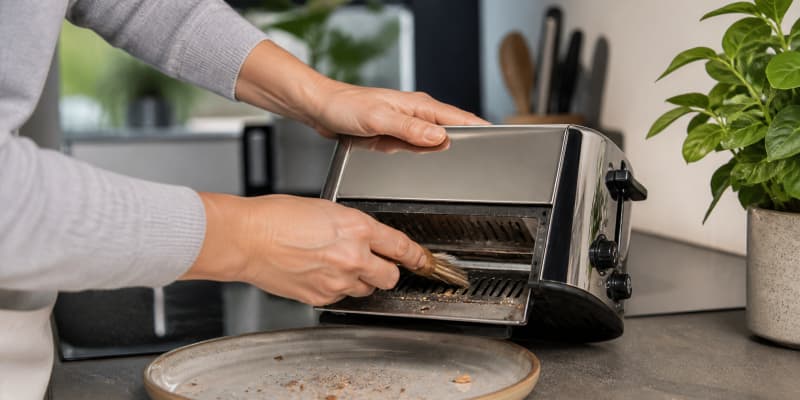
A neglected toaster is not just a fire risk — it also flavours breakfast with yesterday’s crumbs and last week’s melted cheese. Every slice sends fine crumbs through the wire cage and down onto the crumb tray, and the ones that miss the tray end up on the worktop or worse, on the element itself. Learning how to clean a toaster the right way protects the elements, kills smells and takes ten minutes with no chemicals stronger than washing-up liquid. Do it monthly and you will never smell that acrid burnt-crumb morning ever again.
Quick answer
To clean a toaster, unplug it and let it cool completely. Slide out the crumb tray and empty into the bin, then soak it in warm soapy water for ten minutes. Turn the toaster upside down over the sink and tap gently to release loose crumbs. Brush the slots with a soft pastry brush and wipe the exterior with a barely damp microfibre. Never submerge a toaster in water and never insert anything metal into the slots.
Safety first
The one rule that never changes: unplug before you touch it. The elements are exposed inside the slots, and any liquid dripping onto them while plugged in can trip your consumer unit or, worse, cause a shock. Never insert metal — a butter knife, a fork — into the slots even when unplugged; the elements are fragile and easily snapped, and once broken most toasters are not worth repairing. Wait a full ten minutes after last use for the elements to cool.
What you need
- Soft brush (a pastry brush or an old toothbrush)
- Warm soapy water and a microfibre cloth
- Bicarbonate of soda for the crumb tray
- Wooden chopstick or cocktail stick — never metal
- White vinegar in a spray bottle for the exterior
- An old newspaper or baking tray to catch crumbs on the worktop
Step-by-step toaster clean
- Unplug the toaster and let it cool fully — ten minutes minimum.
- Slide out the crumb tray and empty into the bin.
- Soak the tray in warm soapy water for 10 minutes. For sticky grease, add a spoon of bicarbonate of soda.
- Place a sheet of newspaper on the worktop. Turn the toaster upside down over it and gently tap to loosen crumbs.
- Use a soft pastry brush pushed carefully between the slots to dislodge more debris.
- Wipe the exterior with a cloth sprayed with a 50/50 vinegar–water solution.
- Dry the crumb tray fully before refitting — a wet tray warps in the housing.
- Plug in and run one empty toast cycle to burn off any remaining residue — do this with the extractor fan on.
Read also: How to clean an air fryer
Dealing with sticky residue
Butter, jam or melted cheese that has dripped through the slots creates a hard varnish on the element supports. Wooden chopsticks wrapped in a slightly damp microfibre reach in without scratching. Work slowly and never spray cleaner into the slots — the aerosol lingers and evaporates onto your next slice. If a slice of buttered toast has fallen into the slot, unplug the toaster, wait a full hour, and use tweezers or a bamboo skewer to fish it out.
Read also: Small kitchen appliance cleaning checklist
Cleaning a stainless steel exterior
- Spray a mist of white vinegar and buff with a microfibre in the direction of the grain
- For fingerprints, a tiny drop of olive oil on kitchen paper polishes stainless nicely
- Bar Keepers Friend removes water spots — apply, rub in the grain, rinse and dry
- For plastic-bodied toasters, use a mild soap solution only — solvents craze the plastic
Read also: How to descale a kettle
Fixing smells and smoke
Unusually smoky toast usually means the element is coated with old butter or oil. Give the machine a proper clean as above and run the empty toast cycle. If it still smokes, the elements themselves may be at the end of their life — most toasters last five to eight years of daily use. A persistent burnt-plastic smell after cleaning is a red flag; unplug it and replace, do not repair.
How often to clean
- Crumb tray: empty weekly
- Slot shake-out: every fortnight
- Exterior wipe: every few days
- Full clean: monthly
- Deep declutter: quarterly, or before any tenancy inspection
Preventing toast problems
Over-browning on one side often means the element on that side is coated with old grease. A gentle wooden-chopstick clean fixes this. Sudden burnt smells during a normal cycle usually mean a crumb has landed on a hot element — cool, unplug and shake the toaster out over newspaper. If your toast comes out unevenly across four slices in a four-slice toaster, one heating channel is under-performing; check for a slot cover that has come loose. Never insert a fork or knife between slices to check — the risk is electrocution, not merely scratched elements.
Types of toaster and their quirks
Two-slice toasters are the easiest to clean — one crumb tray, two slots. Four-slice toasters have either one long tray or two separate trays; check underneath before pulling. Long-slot toasters (Dualit, Sage The Toast Select Luxe) have a single wide slot for artisan loaves; the elements are longer and pick up more crumbs, so weekly slot brushing matters more. Combi toaster ovens (like the Breville Halo) need the same lemon-steam method as microwaves, plus a wipe of the crumb tray. Whichever style you have, the golden rule is the same: unplug, cool, then clean.
Read also: How to descale a coffee machine
Conclusion
A clean toaster is safer, quieter and tastes better. Empty the crumb tray weekly, tip it upside down fortnightly, and give it a full clean monthly — that is all it takes. If yours sits on a worktop that has not been deep-cleaned in a while — kettle, coffee machine, hob included — book a visit through Maggie’s appliances cleaning in London.
