
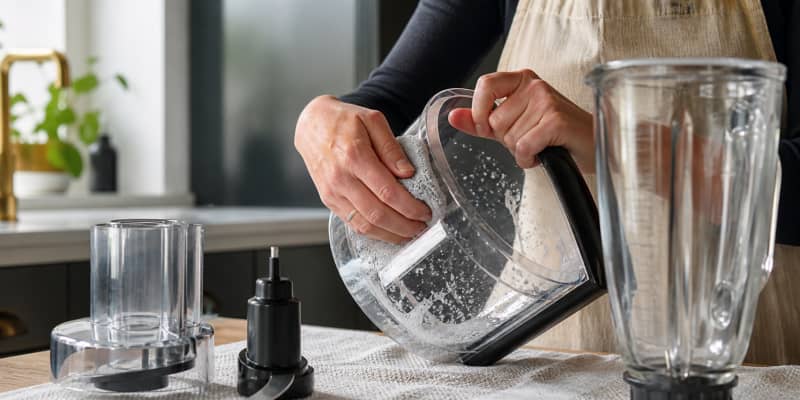
A cloudy jug, a whiff of last week’s smoothie, and a rubber gasket you did not know came out — every blender ends up here. Even the best Ninja, NutriBullet or Vitamix picks up a fatty film after a few weeks of avocados and nut milks, and the residue traps smells long after the drink is gone. Learning how to clean a blender and food processor properly, gasket and all, keeps the motor happy, the blades sharp and the drinks safe. Best of all, most of it can be done in less than a minute with the machine you already have.
Quick answer
To clean a blender, add 500 ml of warm water and one drop of washing-up liquid to the jug, then blend on high for 30 seconds. Pour away, rinse and drain upside down. For deep cleans, unplug the base, unscrew the blade collar, remove the rubber gasket, and hand wash each part in warm soapy water using a bottle brush around the blades. Never submerge the motor base and never wash blades with a cloth or bare hand.
The 30-second self-clean
The best trick for daily use is to fill the jug halfway with warm water, add a small squirt of washing-up liquid, and run the machine on high for half a minute. Pour away, rinse and drain upside down. This works for smoothies, soups and juices — anything without oil. For an oily blend such as pesto or a nut butter, run the same cycle but with a spoon of bicarbonate of soda added; the abrasion of the powder combined with the water breaks up fat brilliantly.
Read also: How to clean a slow cooker
Deep cleaning a blender
- Unplug the motor base.
- Unscrew the blade collar from the base of the jug — most twist counter-clockwise.
- Remove the rubber gasket (silicone O-ring) and check for splits.
- Wash the jug, blade unit and gasket in warm soapy water. Use a bottle brush around the blades — never your fingers.
- Rinse and air dry all parts upside down.
- Wipe the motor base with a barely-damp cloth.
- Reassemble only when everything is fully dry — trapped moisture rusts the drive shaft.
Cleaning a food processor
- Remove the pusher, lid, blade or disc, and bowl in that order
- Wash each part in warm soapy water — most dishwashers accept the bowl and lid, but check the manual (Magimix says hand wash; Ninja says top rack)
- Dry the drive spindle on the motor unit with a dry cloth; do not run water down the shaft
- Wipe the motor housing with a slightly damp cloth
- Store the blades in a designated spot — never loose in a drawer
- Clean the little safety switches with a dry cotton bud — food dust can stop the machine detecting the lid
Read also: Small kitchen appliance cleaning checklist
Dealing with smells
Garlic, onion and curry cling to plastic jugs like nothing else. Fill with equal parts warm water and white vinegar, blend for 30 seconds, then rinse. For stubborn smells, leave a bicarbonate-of-soda-and-water paste in the jug overnight. Lemon halves blitzed with warm water give a bright finish and freshen the plastic. If the jug is still cloudy after weeks of use, buff the inside with a paste of bicarbonate of soda applied on a soft cloth — this shifts the fine scratches that trap the smell.
Tools you’ll need
- Bottle brush with a stiff bristle head
- Washing-up liquid
- Bicarbonate of soda
- White vinegar in a spray bottle
- Microfibre cloths
- Replacement gasket for your model — worth having on hand
When to replace the gasket
Rubber gaskets perish over time — visible cracks, hardening, or a permanent stretched shape mean leaks are on the way. Order a genuine replacement using the model number from the base of the machine. Nutribullet gaskets last around eighteen months of daily use, Vitamix a good five years. A worn gasket is the single most common cause of a “leaking blender”.
Read also: How to clean a toaster safely
Blade safety
- Always wash blades with a brush, never a cloth or your hand
- Store with the blade unit sitting in its original collar
- Never wash blades under running water while pointing towards your palm
- Sharpen? No — replace when they stop chopping ice cleanly, not sharpen
Common mistakes
Do not put a full-size Vitamix jug in the dishwasher — the heat warps the plastic and voids the warranty. Do not leave a wet gasket sitting on the counter overnight; it deforms out of its groove. Do not run the self-clean cycle without a drop of soap; water alone slides over greasy walls without cleaning anything. And do not force a stuck jug off the base when hot — let it cool and it will release with a light twist.
Food processor blade storage
Loose blades in a drawer are the single most common cause of kitchen cuts. Store them in the caddy that came with your food processor, or slot each blade into a purpose-cut foam sleeve. Magimix, Ninja and KitchenAid all sell blade storage boxes; a fifteen-pound investment prevents an A&E visit. Between uses, cover the drive spindle with the machine’s dust cover or an inverted mixing bowl to keep worktop grime out of the drive mechanism.
Conclusion
Thirty seconds after every use and a full disassembly once a month is all a blender or processor needs to run for years. Bottle brush, warm water, a squeeze of washing-up liquid and a stripped-down gasket monthly. For a full worktop reset — appliances, splashbacks and hob — book a visit through Maggie’s appliances cleaning in London.
