
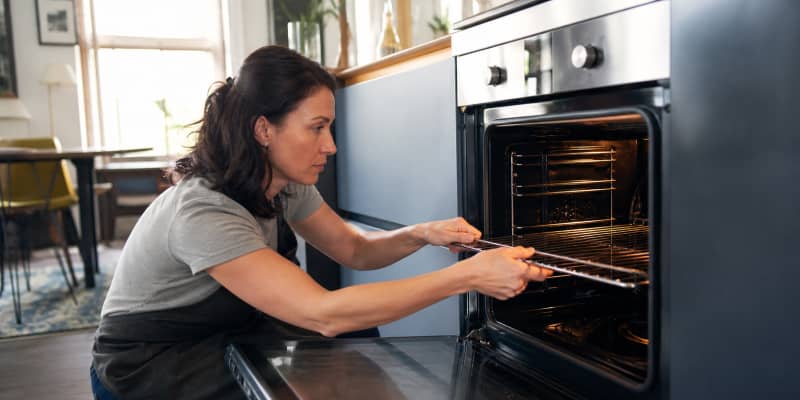
An oven not heating up is one of the most common calls we get, especially around Christmas. The good news is that many faults are simple, some are free to fix, and the ones that need an engineer are usually not expensive. Before you cancel Sunday lunch or call an emergency callout at premium rate, work through the checks in this guide; roughly a third of “dead oven” callouts are solved by clearing a timer program or resetting a tripped breaker.
Quick answer
If your oven is not heating up, first check the timer or clock is not stuck on a delayed program, then check the element visually for breaks. Most “not heating” faults are a failed heating element, thermostat, thermal fuse or fan motor. Isolate the appliance before opening anything, and never bypass a thermal fuse without finding the overheating cause.
Start with the obvious
Before opening anything, work through the free checks:
- Check the clock or timer. Many ovens will not heat unless the clock is set and the timer is not on “auto” or “delay”.
- Check the circuit breaker at the consumer unit; a tripped MCB or RCD often looks like a dead oven.
- Check the temperature dial is not stuck at a light setting after being knocked.
- Check the oven fan is running when set to fan-oven mode.
- Check the door catches close fully; some ovens have a door micro-switch that inhibits heating.
Around a third of the callouts we see for “oven not working” are solved by clearing the timer or resetting a breaker.
Read also: Repair or replace your oven?
Common failed components
Heating element
The fan-oven element is a metal loop at the back of the cavity behind the fan cover. When it fails, it usually blisters or breaks visibly. On top-and-bottom conventional ovens, the top grill or bottom element may fail independently. Replacement elements are typically 25-60 GBP and swap in 20 minutes for a competent DIYer.
Thermostat
The thermostat senses cavity temperature via a capillary tube. If it fails open, the element never heats; if it fails closed, the oven runs away hot. Replacement is a job for a service engineer because the capillary is delicate and must not be kinked.
Thermal fuse
Many modern ovens have a one-shot thermal fuse that trips if the cavity overheats. Overheating causes are usually a blocked cooling vent or a stuck cooling fan. Fuse is cheap (5-15 GBP); finding the root cause matters more than the part.
Fan motor
If the fan is not turning, the element may still glow but heat will not distribute. Listen for a hum or grating noise. Motors are replaceable but you often need to lift the oven out to access from the rear. Common in Bosch, Neff and Siemens ovens after 8-10 years.
Door seal
A perished door seal lets hot air escape, so the oven runs cool at the set temperature. Test by closing the door on a piece of paper; if you can pull the paper out easily, the seal needs replacement.
Read also: How to clean the oven light and change the bulb
Fault by symptom
- Oven completely dead, no lights: circuit breaker, power cable or main PCB.
- Lights on, no heat: element, thermostat or thermal fuse.
- Heats but temperature wrong: thermostat drifting, sensor fault or door seal leaking.
- Heats then cuts out mid-cook: cooling fan or thermal fuse.
- Fan runs but no heat: element.
- Grill works, main oven does not: main element or PCB.
- Error code on display: consult the manual; some indicate NTC sensor failure.
DIY safety rules
If you are comfortable working inside the oven:
- Turn off at the consumer unit and confirm dead with a tester.
- Unplug or isolate at the cooker outlet.
- Photograph every wire before disconnecting.
- Only replace like-for-like parts with the manufacturer part number.
- Never bypass a thermal fuse; find the cause of overheating.
- Never touch mains-carrying components without confirmed isolation.
Read also: Gas cooker installation UK guide
Tools you’ll need
- Multimeter or continuity tester (to check element and thermal fuse).
- Cross and Torx screwdrivers.
- Voltage tester approved to GS38.
- Long-nose pliers.
- Smartphone for photographs of wiring.
When to repair vs replace
An oven under seven years old with a single failed part is usually worth repairing. An oven over 12 years old with two or more faults is often better replaced, especially if parts are becoming hard to source.
Rough guide:
- Repair cost less than 40 per cent of new oven price: fix.
- Repair cost 40-60 per cent: consider replacement.
- Repair cost above 60 per cent: replace, unless the oven is a premium brand.
Premium brands (Miele, Gaggenau, Neff N90) usually justify repair even into year 15 because the rest of the appliance is built to last.
When to call a professional
Call a professional engineer if you find:
- Scorch marks on the terminal block.
- Repeated tripping of the RCD when the oven is switched on.
- A gas oven with any gas smell (call Gas Safe engineer or 0800 111 999).
- An error code you cannot find in the manual.
- Multiple faults on an older appliance.
Conclusion
A cold oven is annoying but rarely mysterious. Once your oven is fixed and heating again, a professional deep clean removes the burnt-in residue that often accumulates while people work around a faulty appliance. Our cooker installation service covers safe replacements when repair is not economic, and our oven cleaning team handles the follow-up. See our coverage for availability.
