
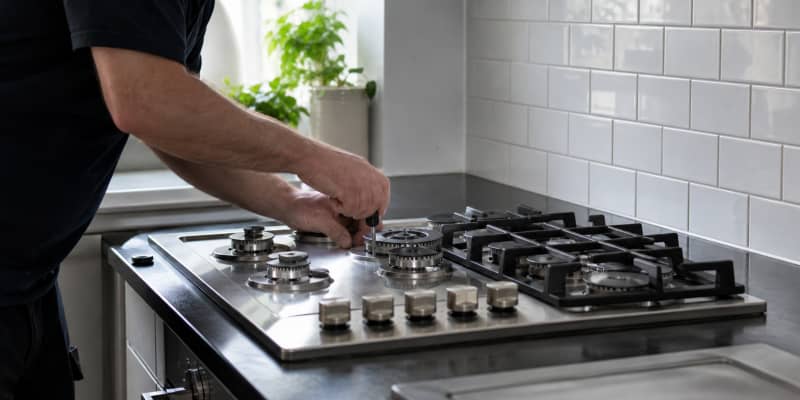
The rules for gas cooker installation UK homeowners must follow are clear: any work on a gas appliance must be done by a Gas Safe registered engineer. Doing it yourself is illegal and dangerous, and cutting corners with a non-Gas Safe fitter puts your home and family at risk. Around 20 people a year die from carbon monoxide poisoning in the UK, and unregistered gas work is behind a disproportionate share. This guide explains the rules, the costs and how to avoid a rogue trader.
Quick answer
Gas cooker installation in the UK must be done by a Gas Safe registered engineer under the Gas Safety (Installation and Use) Regulations 1998. Typical cost is 100-200 GBP for a standard freestanding cooker, more for range cookers or pipe alterations. Ask for the engineer’s photo ID card before work begins and keep the installation certificate for your buildings insurance file.
Why Gas Safe matters
Gas Safe is the official register of engineers qualified to work on gas appliances in the UK. Before Gas Safe (formerly CORGI), thousands of unqualified installations led to carbon monoxide poisonings and gas explosions. The register:
- Verifies the engineer’s qualifications for each type of gas work.
- Issues a photo ID card with a unique reference number.
- Requires re-registration every year with insurance.
- Investigates complaints and can strike engineers off.
- Publishes a searchable register at GasSafeRegister.co.uk.
Read also: How to verify a Gas Safe engineer
What a compliant install includes
A Gas Safe engineer will not simply screw in a bayonet fitting. A compliant install covers:
- Visual inspection of the gas supply pipe, isolator and existing bayonet or rigid connection.
- Tightness test on the gas system with an electronic gauge.
- Connection of the cooker using an approved flexible or rigid pipe (to BS 6172).
- Checking clearances above and to the sides for combustibles.
- Testing every burner for correct combustion and no flame lift.
- Test-firing the oven for burner cross-lighting and thermostat operation.
- Fitting a stability chain or foot to prevent tipping.
- Written record of installation with the engineer’s Gas Safe number.
Ask for the Gas Safe ID card at the door. A legitimate engineer will show it without hesitation, and the card lists the specific gas work categories they are qualified for; “cookers” is a distinct qualification from “boilers” or “meter work”.
Costs to expect
- Freestanding gas cooker like-for-like: 100-200 GBP.
- Range cooker like-for-like: 200-350 GBP.
- New bayonet fitting: add 60-120 GBP.
- Pipe alteration: 150-400 GBP depending on complexity.
- Certificate copy: usually included.
- Same-day emergency work: expect a premium of 30-50 per cent.
Beware quotes far below these ranges; they often signal an unregistered fitter or a “cash only” arrangement that leaves you without cover.
Read also: How to install an electric oven safely
Common installation issues we see
When we clean cookers we frequently find installation problems:
- Missing stability chain on freestanding cookers.
- Old orange rubber hose past its 5-year replacement date.
- Cooker touching a combustible cabinet on one side.
- Kink in the flexible hose behind the cooker.
- Missing or unopened isolator valve.
- Bayonet not fully engaged; small gas leak audible at the connection.
Any of these should trigger a call to a Gas Safe engineer. Do not use a suspect cooker in the meantime.
Regulations for landlords
Landlords have a legal duty under the Gas Safety (Installation and Use) Regulations to have every gas appliance and flue serviced every 12 months by a Gas Safe engineer, and to give tenants a Landlord Gas Safety Record within 28 days. This applies to gas cookers as much as boilers. Penalties for non-compliance start at 6,000 GBP per breach and can include criminal prosecution.
Read also: How to measure for a built-in oven
Disconnection matters too
Disconnecting an old cooker also counts as gas work. Even if you plan to fit an induction hob, do not disconnect the old gas cooker yourself; ask a Gas Safe engineer to cap the pipe or remove the bayonet properly. Uncapped gas points are a common cause of leaks and buildings-insurance disputes after a fire.
Ventilation and clearances
Gas cookers need adequate ventilation, particularly in modern airtight homes. Under Building Regulations Part J, the installer will check permanent ventilation or opening windows. Range cookers with high inputs may require an air brick. Combustible materials (curtains, wooden cabinets) must be kept at least 20 mm from the sides and 750 mm above the hob.
Spotting rogue traders
Warning signs of an unregistered fitter:
- Cash-only prices.
- Reluctance to show a Gas Safe ID card.
- Vague or missing invoice.
- No tightness test after connecting.
- No stability chain fitted.
- Reluctance to use a carbon monoxide analyser.
Report them to Gas Safe if you suspect illegal work. Anyone can check a Gas Safe number online free of charge before allowing work to start.
Conclusion
A compliant gas cooker install is quick, affordable and safe when done by the right person. Our gas cooker installation service in London covers freestanding cookers, range cookers, disconnection and reconnection through fully insured Gas Safe engineers. See our prices and coverage for availability.
