
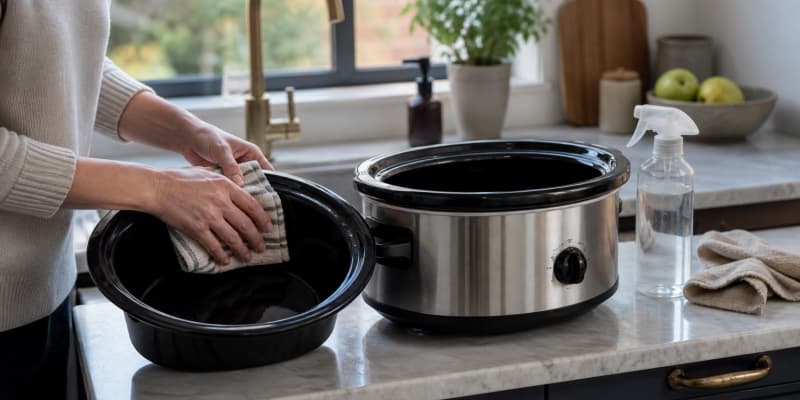
A slow cooker that has done a hundred stews and a dozen chillies eventually wears a brown crust up the sides and a chalky ring inside the pot where the cooking liquid sits for eight hours at a time. Add a few weekend gammon joints and a Christmas mulled wine session, and the ceramic looks tired even after washing up. Learning how to clean a slow cooker — ceramic pot, glass lid and the electric base — brings it back to first-day shine and keeps the seasoning of your favourite recipes tasting the way it should. Ten minutes of care, no expensive products required.
Quick answer
To clean a slow cooker, unplug the base and let the ceramic insert cool slowly (never shock it with cold water). Fill the pot with warm soapy water and leave for an hour, then scrub with a nylon brush. For burnt-on food, sprinkle two tablespoons of bicarbonate of soda across the base, add 200 ml of hot water and 100 ml of white vinegar, return to the base and simmer on Low for one hour with the lid on. Wipe the outer base with a damp cloth only — never submerge it.
Do not thermal-shock the ceramic
The most common way people crack a slow cooker pot is by taking it hot out of the base and pouring cold water in. The ceramic expands unevenly and splits, sometimes right through the base. Always let the pot rest for 20 minutes before it meets water, and start with warm water rather than cold. Never place a cold ceramic insert onto a preheated base either — the same rule applies in reverse. Both Morphy Richards and Crock-Pot warranties explicitly exclude damage from thermal shock.
Cleaning the ceramic insert
- Once cool to touch, fill the pot with warm soapy water and leave for 30–60 minutes.
- Wash with a soft brush or scourer pad — not wire wool, which scratches the glaze.
- For burnt food, sprinkle two tablespoons of bicarbonate of soda across the base, add 200 ml of hot water and 100 ml of white vinegar.
- Return the insert to the base, set to Low, and simmer with the lid on for one hour.
- Unplug, let cool, then wipe clean with a sponge.
- Rinse thoroughly and dry with a tea towel.
Read also: How to clean an air fryer
Removing the water line
Hard-water cookers develop a chalky ring where the cooking liquid sits. Rub this line with a paste of bicarbonate of soda and white vinegar, or use Bar Keepers Friend on a damp cloth. Rinse well and dry. In London the ring returns after every long cook — a monthly deep clean keeps it from becoming permanent, and a quick vinegar wipe after any recipe involving stock or wine helps.
Cleaning the electric base
- Never submerge the base — the heating element and cable enter through the housing
- Wipe the interior of the base with a damp cloth after each use to catch spills
- For stuck-on food inside the base cavity, use a damp cloth wrapped around a wooden spoon handle
- Buff the outside with a microfibre and a spritz of white vinegar to shine stainless steel
- Check the seal around the top rim of the base — food splash sits here undetected
Read also: How to clean a food processor and blender
Glass lid care
The glass lid picks up water spots and a haze of steam residue. Wash in warm soapy water first, then treat mineral spots with white vinegar. The lid’s rubber gasket, if it has one, comes out for cleaning — check the manual before pulling. On Crock-Pot Duraceramic and Ninja Foodi Possible Cooker models the gasket clips into a groove and lifts out for a proper wash. Wash separately in warm soapy water, dry fully, and refit before the next use.
Handles and knobs
- Wipe with a mild all-purpose cleaner
- Dry to prevent water pooling at the base of a plastic handle
- Check that the knob still turns freely — a build-up of grease can seize temperature dials
- Wipe the LCD panel on digital models with a barely-damp microfibre; do not spray directly
Read also: Small kitchen appliance cleaning checklist
Removing tough stains from the ceramic
Turmeric, tomato and heavy paprika stains cling to ceramic glaze. To lift them, mix a paste of bicarbonate of soda and hydrogen peroxide (the three-percent solution from a chemist), apply to the stain, and leave for two hours. Rinse thoroughly. For pale ceramic interiors, this restores the original off-white without scrubbing. Never use bleach — it can degrade the glaze over time.
Storage tips
Store the lid upside down inside the pot so air can circulate — a sealed slow cooker traps moisture and grows mildew. Never coil the cable tightly around the base while warm; the plastic sheath weakens over time. If cupboard space is tight, wrap the cable in a loose loop and secure with a Velcro tie. Store the ceramic insert with a folded tea towel between it and the base to absorb any residual humidity.
Conclusion
Regular gentle care keeps the ceramic glaze intact and the base electrics safe. A hot soak, a nylon brush and a monthly bicarbonate-vinegar simmer is really all the maintenance a slow cooker needs. If your whole worktop of small appliances needs attention, book a professional at Maggie’s appliances cleaning in London.
