
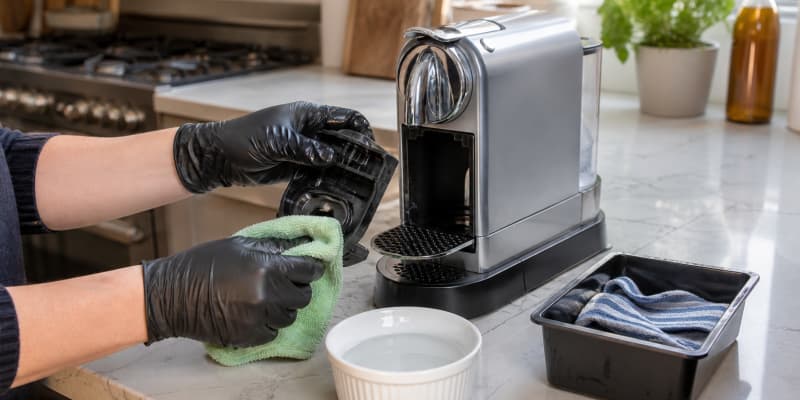
Slow flow, weak crema and a machine that grumbles halfway through a shot are all signs of limescale. In London and most of the South East, tap water contains enough calcium to fur up a coffee machine boiler within a few months — and once scale insulates the heating element, brew temperature drops, extraction turns sour and the pump strains itself out of warranty. Learning how to descale a coffee machine — whether it is a Nespresso, Delonghi or Sage — restores flow, protects the pump and keeps espresso tasting clean. Do it before the machine tells you to, not after.
Quick answer
To descale a coffee machine, fill the water tank with the manufacturer-approved descaler mixed with fresh water as directed on the packet. Enter descale mode from the menu or manual button combination for your model. Run the cycle with a jug under the spouts, then rinse with two full tanks of fresh water before brewing again. Descale every 2–3 months in a hard-water area, or as soon as the machine’s descale light appears. Never use vinegar in an espresso machine — it attacks the rubber seals.
Why descaling matters
London and much of southern England has hard water — around 250 mg/L calcium carbonate on average. Every time you brew, calcium precipitates on the boiler and pipes, choking flow and insulating the heating element. A scaled machine brews cooler, so extraction drops and coffee tastes sour or thin. Descaling every 8–12 weeks in a hard-water area is not optional; leaving it another six months usually costs a new pump or a full replacement. Softer-water areas (parts of Scotland, Wales and Cornwall) can stretch to six monthly.
Read also: How to descale a kettle
Choosing the right descaler
- Nespresso — Nespresso descaling solution or a compatible citric-acid product
- Delonghi — ECODECALK is the manufacturer’s official product
- Sage/Breville — Sage Descaler powder mixed with 1 litre of water
- Bean-to-cup Jura, Miele, Krups — manufacturer-branded solutions only, or citric acid at 20 g per litre
- Avoid vinegar in espresso machines: it is acidic enough to attack the seals
Nespresso descale (Vertuo and OriginalLine)
- Empty the drip tray and capsule container.
- Fill the tank with descaler and water as per the packet ratio (usually 100 ml descaler in 500 ml water).
- Place a large jug (at least 1 L) under the spout.
- Enter descale mode: on most models, press the button for 7 seconds until the light flashes orange.
- Start the cycle — the machine will run water through in bursts for about 20 minutes.
- Refill with fresh water and repeat as a rinse cycle.
- Exit descale mode by holding the button again until the light returns to steady green.
Read also: How to descale a steam oven
Delonghi bean-to-cup descale
Delonghi machines usually flash a red descaler light when it is time. Add 100 ml ECODECALK to the tank followed by fresh water to the descale line. Insert the descale tube if the model has one, or place a 1.5 L jug under the spouts. Follow the on-screen prompts — the machine paces itself through wash and rinse phases automatically. Refill the tank with fresh water when prompted for the rinse. The whole cycle takes about 35 minutes on a Magnifica or Dinamica. Never interrupt the cycle mid-way — the residual acid can damage internal pipework.
Sage / Breville espresso machines
Access the descale menu on a Sage Barista Express by pressing the 2-cup and Power buttons together. Dissolve one Sage descaler sachet in 1 litre of warm water and pour into the tank. Follow prompts through descale and rinse phases — the whole process is around 25 minutes and cycles the solution through both the coffee boiler and the steam boiler separately. Wipe the group head with a soft brush afterwards and backflush with the supplied blind basket and Sage Espresso Machine Cleaner tablet.
The citric acid alternative
Citric acid is chemically similar to the active ingredient in most branded descalers and costs a fraction. Dissolve 20 g of citric acid powder in one litre of warm water and use as you would any descaler. It is food-safe, odourless and rinses away cleanly. Confirm your machine warranty allows citric acid before use — Nespresso and Delonghi permit it; some Miele and Jura machines do not.
Daily and weekly care
- Wipe the steam wand after every milk drink and purge steam through for two seconds
- Purge the group head between shots
- Rinse the drip tray daily
- Backflush espresso machines weekly if the manual supports it
- Empty and refill the water tank daily — stagnant water breeds bacteria
Read also: Small kitchen appliance cleaning checklist
Signs you have left it too long
Espresso trickling instead of streaming, milk that will not foam past a bubble, an unusually loud pump on start-up, and coffee cooler than it used to be at the cup — all point to serious scaling. If your descale cycle completes but performance does not return, a professional decalcifying service or a service technician’s flush may be needed. Never dismantle a machine yourself if it is still under warranty.
Conclusion
A descaled machine pulls faster shots, foams milk properly and lasts years longer. Nespresso every eight weeks, Delonghi and Sage on the machine’s own prompt, and a cheap citric-acid cycle in between if you brew several cups a day. If your whole kitchen — coffee corner included — needs an overhaul, book a visit through Maggie’s appliances cleaning in London.
