
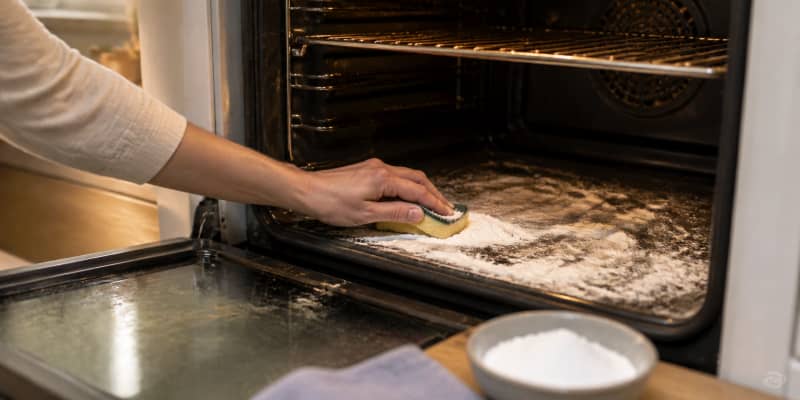
Before commercial oven sprays and dishwasher tablets, home cooks reached for salt. Cleaning oven with salt is an old-school natural oven cleaner recipe that still holds up today, especially for fresh spills. It costs almost nothing, it is completely food-safe, and it is already in every kitchen. The trick is knowing when to use it as the main event and when to combine it with other pantry staples for a stronger result. Here is why it works, when to use it, and how to combine it with modern tricks.
Quick answer
To clean an oven with salt, sprinkle a generous layer over a fresh spill while the oven is still warm. The salt absorbs the moisture and carbonises the residue into a dry crust you can lift out with a scraper once cool. For deeper grime, mix two tablespoons of salt with four tablespoons of baking soda and enough water to make a paste, spread across the interior, and leave for at least four hours.
Why salt works as a natural oven cleaner
Salt does three useful things at once. It absorbs liquid, so a spill soaks up rather than spreading. It raises the localised temperature slightly, drying the food faster. And it acts as a mild abrasive when you scrub. That combination is why grandmothers reached for it long before Cif existed. Coarse salt works even better than fine because the larger crystals provide more scrubbing power.
Read also: Cleaning Your Oven with Vinegar and Baking Soda
The classic salt method (for fresh spills)
Here is how to do it in real time when a pie bubbles over.
- Turn off the oven and open the door briefly.
- Sprinkle a thick layer of salt directly on the spill.
- Close the door and finish cooking – the salt bakes onto the residue.
- Let the oven cool.
- Scrape the dry crust out with a plastic scraper.
- Wipe with a damp cloth.
Best type of salt to use
Plain fine table salt works well, but coarse sea salt or kosher salt gives more abrasion and absorbs slightly more moisture. Avoid flavoured or herb salts – the extras will burn and smell awful. Cheap supermarket own-brand cooking salt is perfect for the job; there is no need to sacrifice the good Maldon.
Salt combined with baking soda cleaning
For deeper cleans, salt becomes an ingredient rather than the whole method. Mix these into a paste for a homemade cleaning products recipe that works surprisingly well:
- 2 tablespoons of salt
- 4 tablespoons of baking soda
- 2 tablespoons of white vinegar
- Enough warm water to make a spreadable paste
Spread on the interior, leave for at least 4 hours, then scrub with a nylon pad. The salt gives grip, the baking soda softens, and the vinegar dissolves the residue as you wipe.
Read also: How to Remove Burnt-On Grease from Your Oven
A natural oven cleaner recipe using salt and lemon
Rub half a lemon dipped in salt across the oven glass and lightly-soiled interior. The acid in the lemon breaks grease bonds while the salt scrubs. Wipe with a wet cloth and buff dry for a clean, citrus-scented finish. This is particularly good on the oven door glass where you can see immediate results.
Limits of the salt method
Salt is superb for fresh spills and mild grime, but it will not shift decades-old carbon on its own. Use it as a maintenance tool, not the sole solution when your oven is heavily neglected. For that, you need alkaline dwell time – baking soda paste overnight, or a commercial degreaser.
Read also: How to Clean Your Oven with Lemon
Common mistakes to avoid
The main mistake with salt is trying to use it as a scouring powder on cold, hardened grease – it does nothing. Salt only helps when there is moisture to absorb, so apply either to a fresh spill or as part of a wet paste with baking soda. Another mistake is using it on stainless steel accessories: salt can pit stainless if left in prolonged contact.
Keeping your oven clean the natural way
Combine salt spill-catching with a weekly wipe of vinegar and warm water. Empty the crumb tray beneath the door every fortnight. Keep a small bowl of bicarbonate in the cavity when unused to absorb residual odours. Line the bottom shelf with a silicone mat or a sheet of baking parchment to catch drips before they burn on.
How often to use the salt trick
Salt is a real-time tool rather than a scheduled clean. Reach for it every time you see a spill start to bubble, especially with sugary pies or cheesy bakes. As part of a full clean, use the salt-baking soda paste every second month, alternating with pure bicarbonate for the months in between.
Conclusion
Salt is a genuinely useful old-fashioned cleaning tool, especially for catching spills before they become tomorrow’s carbon crust. For built-up grime that home tricks can’t fix, our fume-free professional oven cleaning service in London restores every surface using food-safe products.
