
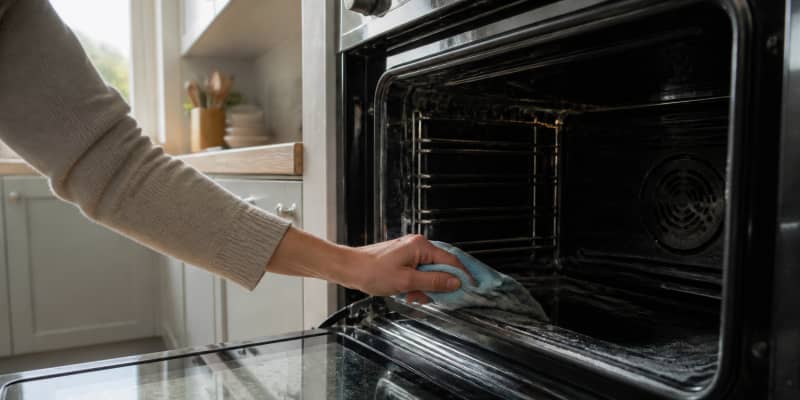
Chemical oven sprays get the job done but leave fumes and residue nobody enjoys living with, especially in a small London flat where the kitchen shares air with the living room. Learning to clean oven with vinegar and baking soda is not just a green trend – it works beautifully, especially on regular grime. The combination has been used by home cooks for a century, and it is still the exact chemistry we reach for on customer jobs where children or pets are around. Here is the method professionals fall back on when a customer wants a fume-free deep clean.
Quick answer
To clean an oven with vinegar and baking soda, spread a thick paste of half a cup of baking soda and three tablespoons of water inside the oven, leave overnight, wipe out, then spray white vinegar across the surfaces. The vinegar reacts with any leftover residue, which you wipe away with a damp microfibre. Repeat the process on stubborn spots and always use white vinegar, never malt or cider.
Why vinegar and baking soda work
Baking soda is a mild alkaline abrasive that draws grease out and cushions delicate enamel. Vinegar is a mild acid that dissolves alkaline residue and leaves the surface streak-free. Used in sequence, they cover the whole cleaning spectrum without releasing volatile fumes. It is the same chemistry principle behind laboratory glassware cleaning – alkaline first, acid rinse – just applied to an appliance.
Read also: How to Clean an Oven: The Complete UK Guide
Tools you’ll need
The whole kit costs less than a takeaway coffee. Keep it under the sink.
- Half a cup of bicarbonate of soda
- 500 ml spray bottle of white vinegar (5 percent acidity)
- Three fresh microfibre cloths
- A plastic scraper
- Rubber gloves
- Optional: a squirt of Ecover washing-up liquid for greasier jobs
How to clean oven with baking soda and vinegar
Follow this step-by-step and even a heavily used oven will look renewed by morning.
- Remove racks, side rails, and trays.
- Mix half a cup of bicarbonate of soda with 3 tablespoons of water.
- Spread across every interior surface, avoiding the heating element.
- Leave overnight (minimum 8 hours).
- Wipe out with a wet microfibre in the morning.
- Fill a spray bottle with white vinegar and mist the interior.
- Wipe again – the residue foams away with the vinegar.
- Buff dry with a final clean microfibre.
Best types of vinegar to use
White vinegar oven cleaner works best because it is colourless and food-grade. Malt or cider vinegar can stain and leave a distinct smell. A 5 percent acidity distilled white vinegar from any supermarket is perfect – Sarsons and supermarket own-brand both work. Cleaning vinegar (usually 6 percent) works marginally better on limescale but the extra strength is rarely needed on an oven.
Natural oven cleaner: extra ingredients
For extra lift, tailor the paste to your grime level.
- Squeeze in fresh lemon juice for a fresh scent and mild extra acid
- Add a tablespoon of washing-up liquid for greasier ovens
- Use warm water rather than cold to make the paste spread easier
- A pinch of table salt boosts abrasion on stubborn spots
- Add a few drops of essential oil (lavender, tea tree) for scent
Read also: Natural Homemade Oven Cleaners
Baking soda cleaning: tips from the pros
A few refinements make all the difference. Warm the oven slightly (fan off, door open) for five minutes before applying paste – the mild heat helps it grip. Use a spatula or plastic scraper to reach corners. Never scrub with anything metallic; stick to nylon pads or a soft brush. If you have a stainless-steel interior, do a small patch test first, as bicarbonate can dull the finish slightly.
When natural is not enough
If your oven has more than a year of ignored grime, expect two overnight sessions. Deeply carbonised layers may still need a caustic-free professional degreaser. That is not a failure of the method – it just means the residue is beyond home chemistry. End-of-tenancy grease often falls into this category.
Read also: Cleaning an Oven with Baking Soda
Common mistakes to avoid
The single biggest error is mixing the vinegar and baking soda in a bowl before applying – the reaction happens in a bowl, not on the grease, and the paste loses all effectiveness. Always apply baking soda first, let it work overnight, then finish with vinegar. Another common mistake is using too much water in the paste, making a runny slurry that drips off vertical surfaces. Aim for toothpaste consistency.
Maintaining the shine
Once your oven is spotless, keep it that way with a five-minute weekly wipe. Warm the oven for a few minutes, spray with a solution of one cup water, half a cup of vinegar, and a teaspoon of baking soda. Wipe out with a fresh cloth. That simple habit prevents 90 percent of the build-up. Line the bottom shelf with a silicone oven liner to catch drips.
Conclusion
Cleaning your oven with vinegar and baking soda is the safest, most affordable, and most eco-friendly method for regular upkeep. When your oven is beyond home methods, our team uses non-toxic professional products in every oven cleaning service across London – safe for pets, kids, and food surfaces.
