
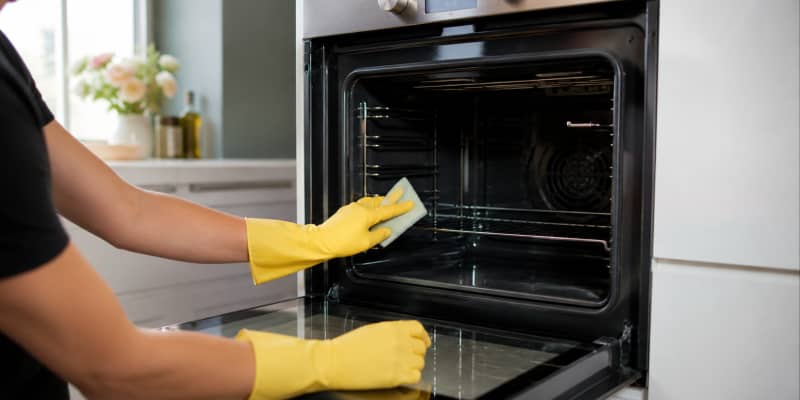
Smeg’s retro-style ovens are as much interior statement as cooking appliance, with pastel greens, cream and post-box red enamel exteriors turning kitchens into design pieces. Behind that showy front, Smeg build serious ovens with pyrolytic, Vapor Clean or standard enamel interiors — each needing a matched cleaning method. Learning how to clean a Smeg oven protects both the finish and the coloured door panel that makes the brand recognisable, and keeps the internal enamel in perfect condition for the fifteen-plus years these ovens can serve.
Quick answer
To clean a Smeg oven, use the pyrolytic self-clean cycle if fitted — remove all shelves, rails and accessories first, then select Pyrolysis (Eco 90 min for light soiling, Auto for heavy). For Vapor Clean models, pour 200 ml of cold water into the small depression in the base and run the 30-minute steam cycle. For manual cleaning, apply a bicarbonate-of-soda paste overnight and wipe away. Never use caustic oven cleaner on the enamel, and never use anything abrasive on the coloured exterior.
Identifying your Smeg
- Pyrolytic — has a Pyrolysis setting on the dial or display and a door-lock indicator
- Vapor Clean — has a Vapor Clean icon (looks like steam over a dish)
- Ever-clean enamel — a smooth easy-wipe interior, no self-clean cycle
- Standard enamel — no self-clean feature, cleaned manually
Check the manual or model plate inside the door frame if unsure. The model number starts with SF, SFP or SO depending on the range.
Pyrolytic self-clean method
- Remove shelves, side rails and any accessories — none survive pyrolysis.
- Wipe out large loose debris and drain any pooled fat with a paper towel.
- Close the door and select Pyrolysis.
- Choose duration: Eco (90 min) for light, Auto for heavy.
- The door locks automatically until the cavity cools below 300 °C.
- Open once unlocked and wipe out the fine white ash.
- Wash the shelves in the sink with hot soapy water and dry immediately.
Read also: How to clean a Neff oven
Vapor Clean method
- Cool the oven fully.
- Pour 200 ml of cold water into the small dip in the oven base.
- Close the door and select Vapor Clean (usually 30 minutes at 100 °C).
- When finished, wipe out the softened residue with a damp cloth.
- Follow with a bicarbonate paste on any stubborn patches.
Vapor Clean is best for weekly light residues, not for months of caked grease. Use it as a weekly maintenance cycle rather than a rescue cycle.
Read also: How to clean a Bosch oven
Manual cleaning safely
- Mix bicarbonate of soda with warm water into a spreadable paste
- Apply to interior enamel, avoiding fan cover and element
- Leave overnight — at least 12 hours
- Wipe away with a damp microfibre
- Spray any remaining spots with white vinegar to lift by reaction
- Rinse with clean water and dry with a soft cloth
Cleaning the coloured door panel
Smeg’s coloured enamel exteriors — pastel green, cream, red, black — are hard-wearing but not scratch-proof. Clean with a microfibre and warm soapy water, then buff dry immediately to avoid streaks. Never use scourers, bleach or wire wool — the surface will show hairline scratches under kitchen lights, and these cannot be polished out. For fingerprints and greasy marks, a barely-damp microfibre wiped in one direction lifts more than any spray cleaner. Astonish Specialist Ceramic & Glass on a soft cloth is safe for stubborn patches.
Removing fingerprints from stainless trim
- Wipe in the direction of the grain
- Use a tiny amount of stainless steel polish, not oil
- Buff with a lint-free cloth for a streak-free finish
- For water spots, a squeeze of lemon juice on a cloth works brilliantly
Read also: Remove stains from AGA enamel
Door glass strip-down
- Open the door, press the hinge locking tabs.
- Lift the door out and lay it flat on a towel.
- Slide the retaining strip at the top to release the inner glass.
- Clean flat with bicarbonate paste or a glass cleaner.
- Dry, refit the inner pane in the correct orientation, and refit the door into the hinge slots.
Retro range specifics
The Victoria and Portofino range cookers add a chrome trim strip along the front edge — polish this with a chrome-safe cream (Autosol works well) rather than steel polish, which can pit chrome over time. The knobs are removable on most Smeg range cookers: pull straight off, soak in warm soapy water, dry fully and refit. Never twist a knob if it feels stuck; the plastic spindle underneath is fragile.
Preventive care
Wipe up any spill on the coloured enamel exterior within minutes — even weak vinaigrette left overnight can leave a faint stain on cream Smeg. Line the oven base with a reusable oven mat during roasts, but never place foil directly on the base of a pyrolytic Smeg (it can reflect heat and damage the enamel). Empty the drip tray in slide-and-hide models after every roast.
Cleaning Smeg range cooker hobs
Smeg range cookers combine gas burners, ceramic hobs or induction depending on the model. Lift the cast iron pan supports carefully — they are heavy and can chip enamel. Soak in hot water with soda crystals for one hour, scrub with a nylon brush, dry immediately and season lightly with vegetable oil to prevent rust. For ceramic and induction tops, use Cerapol or Hob Brite on a soft cloth, never scouring pads. Scrape hardened deposits at a 30-degree angle with a plastic hob scraper — Smeg supply one with every range cooker.
Conclusion
Careful, matched cleaning keeps Smeg’s enamel and coloured finish looking new — bicarbonate paste for the interior, warm soapy microfibre for the coloured door, and the right self-clean cycle for the model. For an annual deep clean that respects the pyrolytic lining and the coloured exterior, book a professional at Maggie’s oven cleaning in London.
