
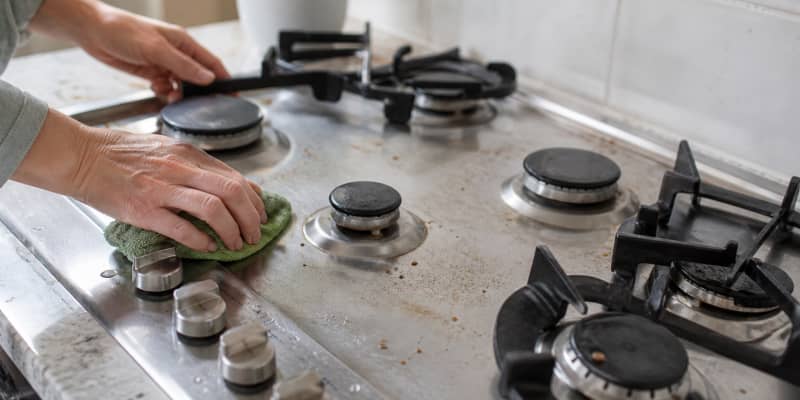
A gas hob has more removable parts than any other kind of cooktop, and each of them needs a slightly different clean. Cast-iron grates, brass or steel burner caps, ceramic burner heads, and the enamel or stainless-steel base underneath all collect grease in their own way. Learning how to clean a gas hob properly, without blocking the burner ports or ruining the finish, keeps the flame blue and the cooking even.
Quick answer
To clean a gas hob, isolate the appliance, lift off the pan supports and burner caps, and soak them in warm soapy water. Wipe the hob base with a bicarbonate paste, dry it, and refit each burner in the right place. Never poke the burner ports with a metal pin; use a wooden cocktail stick or a soft brush.
Why a gas hob needs a different routine
Every element of a gas hob is designed to be lifted for cleaning, and every element needs to go back exactly where it came from for the flame to burn correctly. Cast iron pan supports need drying immediately to stop rust. Brass burner caps discolour with harsh cleaners. Steel burner heads have precisely drilled ports that must be kept clear to give a clean blue flame. And under it all, the enamel or stainless base traps every spill within a tight rim. A gas hob is not harder to clean than an induction one — it is just more of a routine.
Read also: How to clean cast iron hob grates
What you’ll need
- Rubber gloves
- Warm soapy water — Ecover or Method washing-up liquid
- Bicarbonate of soda and white vinegar
- A soft brush or old toothbrush
- A wooden cocktail stick for burner ports
- Two or three e-cloths
- An old towel for the counter
Step-by-step method
- Turn off the gas supply at the isolator, or at the very least make sure every knob is at the off position.
- Let the hob cool completely.
- Lift off the pan supports and set them on an old towel.
- Lift off each burner cap and burner head, keeping pairs together so nothing gets muddled.
- Soak the pan supports and caps in warm soapy water for twenty minutes.
- While they soak, spread a bicarbonate paste (three parts powder to one part water) across the hob base, avoiding the ignition ports directly. Leave for twenty minutes.
- Wipe the paste off with a damp e-cloth, working from the back to the front.
- Mist a little white vinegar to lift residue and buff dry.
- Scrub the pan supports and caps with a soft brush, rinse and dry fully.
- Clear each burner port with a wooden cocktail stick — one hole at a time, no metal.
- Refit burner heads, caps, then pan supports.
- Turn the gas back on and light each burner briefly to confirm a blue flame across all ports.
Cast iron vs steel vs brass burners
Cast iron grates
Dry immediately after washing to prevent rust. A quick wipe with a drop of vegetable oil on the underside protects the finish between cleans.
Steel burner heads and caps
Fine with soapy water and a soft brush. Never dishwasher — the enamel coating cracks over time.
Brass caps
Wipe only with soapy water. Do not use vinegar, Bar Keepers Friend, or metal polish on brass burners unless the manual specifically says so — the plating is thin.
Read also: How to clean an induction hob
Ignition, flame colour and safety
The tiny ceramic ignition ports beside each burner need to stay dry. If yours is not clicking after cleaning, dry it with a corner of kitchen paper and wait ten minutes before trying again. The flame itself is a diagnostic tool: a blue, steady flame with a small yellow tip is normal. A mostly yellow flame after cleaning usually means a burner head is refitted incorrectly or a port is blocked. Turn the gas off, recheck and refit. If the flame stays yellow, call a Gas Safe engineer — do not keep using it.
How often to clean
Wipe the hob base and pan supports after every heavy cook. Do a full strip and clean, taking every burner off, once a fortnight. Cast iron grates benefit from a light oiling every month if you live in a humid basement flat where rust starts fast. The knobs and control panel need only a barely damp cloth — never spray cleaner directly onto them because moisture wicks down the shaft into the gas valve and eventually causes a sticky knob or worse.
Gas vs induction — a quick word on cleaning
People often ask whether gas vs induction changes the amount of cleaning. It does. A gas hob asks for more frequent quick cleans because grease escapes around the pan supports; an induction hob asks for careful gentle cleans because every mark shows. Neither is harder overall — they just reward different habits. If you cook on both because you have a range with mixed rings, treat each zone by its own rules.
Conclusion
A clean gas hob is a safer gas hob. Blue flames, clear ports and dry cast iron all come from ten minutes of routine every fortnight. If yours has been neglected for months or the flame is not what it used to be, book our appliances cleaning service in London and we will strip, clean and refit every burner for you.
