
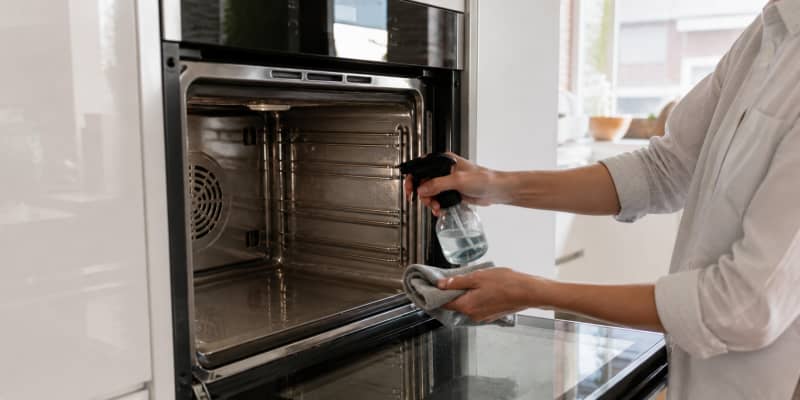
Every steam oven, no matter how clever, is only as good as the water inside it. Over weeks, minerals from tap water settle in the evaporator, on the steam outlets and on the door glass, and the cooking cycles get slower and less powerful. Learning how to descale a steam oven properly protects both the flavour of your food and the seals inside the machine, and it takes about half an hour once a month.
Quick answer
To descale a steam oven, fill the water tank with the manufacturer’s descaler or a food-safe citric acid solution at 20 grams per litre, then run the built-in descale programme. Once complete, run a rinse cycle with fresh water and wipe the cavity dry. Descale every month in hard-water areas, every three months in soft-water areas.
Why steam ovens scale up so fast
London tap water is hard: around 260 to 300 parts per million of calcium carbonate depending on borough. That mineral is invisible in a glass of water but very visible on a heater plate. In a steam oven the water is boiled again and again, and every gram of scale that forms in a kettle forms here too — with the added twist that it can end up on the food. If you have noticed the steam looks weaker than it used to, the cycle runs longer, or there is a white haze on the door glass, the evaporator needs descaling.
Read also: How to clean a steam oven correctly
What you’ll need
- The manufacturer’s steam oven descaler (Miele, Bosch, Neff, Siemens, Samsung and AEG all sell their own)
- Or food-safe citric acid powder if your manual permits it
- A jug and a set of scales
- An e-cloth or two soft microfibre cloths
- The manual, or the app for smart models
If your manual mentions Delonghi ECODECALK or Nespresso descaler, those are for coffee machines specifically. Do not use them in an oven unless the oven manual names them.
Step-by-step: the descaling cycle
- Empty and rinse the water tank. Wipe it dry with a soft cloth.
- Weigh out the descaler. For citric acid, 20 grams per litre of water is the standard concentration; check your manual first.
- Dissolve the descaler in warm water in a jug. Pour it into the tank.
- Start the built-in descaling programme. On most models this is in the settings menu and takes 20 to 40 minutes.
- Wait until the programme finishes. Do not open the door mid-cycle — the descaler solution is hot and acidic.
- Empty the tank and refill with fresh water. Run the rinse cycle. If your model does not have one, run the shortest steam programme with an empty cavity.
- Repeat the rinse if you can still smell citric acid.
- Wipe the cavity dry with an e-cloth and leave the door open for an hour.
Between descales — daily habits that keep scale down
Empty the tank after every use
Standing water is where scale starts. Empty, rinse, dry, close.
Use filtered water in hard-water areas
A jug filter drops calcium content and slows scale formation. Distilled water is even better but overkill for most households.
Wipe the door glass daily
The inside of the door is where scale first shows up because condensation lands there. A soft e-cloth wipe after each cook stops a haze forming.
Read also: How to descale a kettle with citric acid
What not to do
Do not use vinegar as a routine descaler in a steam oven. It works in a pinch but the acid can attack rubber seals over time. Do not use a kettle descaler that contains sulphamic acid unless the manual specifically permits it. Do not skip the rinse — descaler left in the tank taints the next meal. And do not attempt to open a sealed evaporator to descale it manually; that is an engineer job and dismantling it voids most warranties.
When to call an engineer
If the descale cycle finishes but the steam is still weak, or if the machine flashes a descale error immediately after descaling, there is a blockage further inside the appliance. A service engineer can dismantle the evaporator, flush the internal pipes and reset the descaling counter. In central London we see this most often in homes where the machine has been used without descaling for two or more years — by which time citric acid alone is no longer enough to shift the mineral build-up in the internal pipework.
Conclusion
Descaling a steam oven is the single habit that keeps the machine cooking as well as it did on day one. Do it monthly in hard water, empty the tank after every use, and stick to the descaler in the manual rather than reaching for the nearest bottle of vinegar. If your oven is showing errors that will not clear or the steam is not what it was, book a professional oven cleaning in London and we will service the evaporator alongside a deep clean.
