
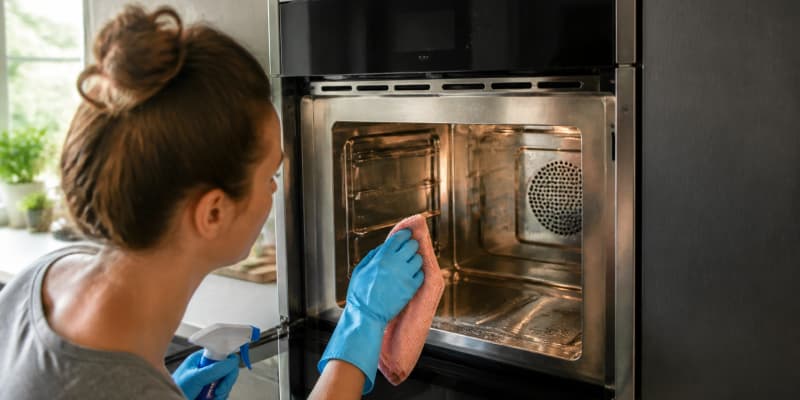
A steam oven cooks with moisture rather than dry heat, which means it produces almost no baked-on grease and yet develops a whole set of cleaning problems a conventional oven never has: limescale, water stains, cloudy glass and a mineral crust around the steam outlets. Learning how to clean a steam oven properly keeps the flavour of your food neutral and stops the water system from clogging.
Quick answer
To clean a steam oven, empty the water tank after every use, run the built-in cleaning cycle weekly, and descale monthly with citric acid or the manufacturer’s descaler. Wipe the cavity with a soft e-cloth and warm water only — no bicarbonate paste, no vinegar sprays inside the cavity, and no abrasive pads on the stainless-steel walls.
How a steam oven works, and why cleaning is different
A steam oven boils water in a small reservoir and injects the vapour into the cavity, sometimes on its own and sometimes alongside a conventional convection element in a combi model. That means two things for cleaning. First, mineral content from tap water leaves scale wherever the steam condenses — around the outlets, on the roof, and on the door glass. Second, because there is very little airborne grease, harsh chemistry is not needed and would actually damage the finish. Steam oven cleaning is more like descaling a kettle than degreasing a roast oven, and the same rules about acid and time apply.
What you’ll need
- Distilled or filtered water for the tank if you live in a hard-water area
- Citric acid powder or the manufacturer’s steam oven descaler
- An e-cloth or two soft microfibre cloths
- Washing-up liquid — Ecover or Method
- A soft toothbrush for the steam outlets
- The oven’s manual, or the app if it is a smart model
Step-by-step: weekly steam clean oven routine
- Empty the water tank and rinse it in the sink with warm water. Never leave standing water in the reservoir overnight — it grows bacteria and encourages scale.
- Take out the shelves and side rails. Wash in warm soapy water and dry fully.
- Fill the tank with fresh water and run the built-in cleaning cycle if your model has one. On most Miele, Bosch, Neff and Siemens steam ovens this is called an evaporator clean or auto-clean and takes 20 to 30 minutes.
- Once the cycle ends and the cavity has cooled, wipe the walls, roof and floor with a soft e-cloth and warm water.
- Dry with a fresh cloth and leave the door open for at least an hour so the interior fully airs.
Read also: How to descale a steam oven
Descaling the water system
Descaling is the single most important job on a steam oven, and the one most owners forget. If you notice the steam is weaker, the cycle takes longer, or you can see white crust around the outlets on the ceiling of the cavity, it is scale. Use a steam oven descaler recommended by the manufacturer, or a food-safe citric acid solution at 20 grams per litre of water. Pour it into the tank, run the descaling programme, and repeat with plain water afterwards to flush the system. Never use a kettle descaler labelled for other appliances unless the manual says so — some contain sulphamic acid that damages steam-oven seals.
Cavity, door glass and steam outlets
Cavity
Stainless-steel steam cavities do not need a paste. Warm water and a soft e-cloth is enough for the walls; a drop of washing-up liquid is enough for the floor if anything has spilled.
Door glass
Water spots on the inner glass wipe off with warm water and an e-cloth. If they are stubborn after descaling the tank, a very light citric acid solution on the cloth (not sprayed) lifts them.
Steam outlets
Use a soft toothbrush to clear the small holes on the roof of the cavity. Blocked outlets are why steam distribution goes uneven and cakes rise on one side more than the other.
Read also: How to use a self-cleaning oven safely
What not to do
Do not use oven cleaner sprays inside a steam oven. Do not use bicarbonate paste — the abrasion marks stainless. Do not use vinegar as a permanent descaler; it is fine occasionally but the manufacturer’s descaler is designed for the seals. And do not leave water in the tank between uses. Empty, dry, done — every single time you finish a cycle.
Conclusion
A steam oven is one of the easiest appliances in the kitchen to keep clean as long as you accept that convection oven cleaning habits do not apply. Empty the tank, run the cleaning cycle weekly, descale monthly, and never reach for abrasives. If yours has been running slow or leaving marks on the glass and you would rather someone else sort it, book a professional oven cleaning in London and we will service the tank and cavity together.
