
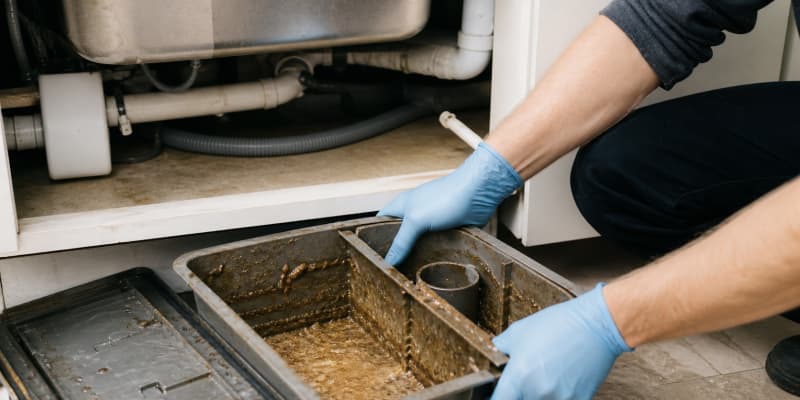
Getting grease trap cleaning UK requirements right is a legal and practical must for any commercial kitchen. Untreated fat, oil and grease (FOG) is the number one cause of drain blockages and fatbergs in the sewer network, and water companies are increasingly enforcing action against premises that discharge it. Thames Water alone spends millions each year clearing London’s sewers, and the cost is passed back to the source premises whenever they can prove it.
Quick answer
UK commercial kitchens must fit and maintain a grease trap or interceptor sized for their output, and empty and clean it at intervals that keep FOG below 25 per cent of the trap volume. Typical intervals are every 2-6 weeks depending on trap size and cooking style. Keep waste transfer notes for at least two years as proof of compliance.
Why grease traps are a legal issue
Under the Water Industry Act 1991, it is illegal to discharge material that could cause damage or blockage to public sewers. Local water companies (Thames Water in London, for instance) enforce this through the Building Regulations H1 and section 111 of the Act.
Non-compliance can lead to:
- Refusal to accept trade effluent.
- Recovery of unblocking costs from the premises.
- Prosecution and unlimited fines.
- EHO enforcement if drains back up into the kitchen.
- Loss of premises licence in the worst cases.
Read also: TR19 grease extraction cleaning explained
How often should you empty a grease trap?
There is no single number in law; the requirement is that fat and solids do not exceed 25 per cent of the trap volume. In practice, that translates to:
- Small under-sink traps (25 litres): every 2-4 weeks.
- Passive traps (100-200 litres): every 4-8 weeks.
- Automatic grease recovery units (GRUs): daily skimming, monthly deep clean.
- External interceptors (500-2000 litres): every 8-12 weeks.
Kitchens producing heavy fry, wok or roast output should shorten these intervals. Keep the last three visits’ certificates available for inspection. Ask your contractor to leave a small volume indicator or dip stick so your KP can check between visits.
What good cleaning looks like
A compliant grease trap clean is a full empty, scrape and rinse; simply skimming the top layer is not enough.
- Contents pumped out and taken away under a waste transfer note.
- Baffles removed and washed.
- Trap walls scraped free of solidified fat.
- Inlet and outlet pipes rodded and checked.
- Water refilled and lid resealed.
- Waste transfer note issued.
- Photo evidence uploaded to your compliance portal if the contractor offers one.
Read also: Kitchen fire safety rules
Choosing the right trap size
A trap that is too small blocks quickly and lets fat pass. Size is calculated by the flow rate of your sinks and the volume of grease-bearing water produced per hour. Pubs with a small kitchen may only need a 50-litre passive trap; a busy restaurant with three deep sinks needs an external interceptor.
If you are planning a new site, involve a drainage consultant before finalising layouts. Retrofitting a bigger trap is far more expensive than fitting the right one first time. In London, Thames Water publish sizing guidance and will accept enquiries for advice on trade effluent consent.
Everyday practices that extend intervals
- Scrape plates and pans into food waste, not sinks.
- Cool fryer oil and dispose in the used-oil tank, never down drains.
- Fit strainers in every sink and empty into food waste.
- Wipe pans with kitchen roll before washing.
- Avoid pouring near-boiling water into drains after cleaning; hot water carries grease further before it congeals.
- Consider a biological dosing unit that adds fat-degrading bacteria to the drain nightly.
Read also: EHO compliance checklist
Signs your trap needs attention now
- Sinks draining more slowly than usual.
- Foul odour from floor gullies or the trap lid.
- Grease visible in the outlet pipe after opening the lid.
- Trap water level rising above the outlet weir.
- Flies or drain-loving pests around the trap area.
Any of these signals should trigger an emergency call before your scheduled visit.
Documentation for inspections
Keep waste transfer notes for a minimum of two years. EHOs and water companies both accept these as proof of compliance. Store them in your food safety folder alongside cleaning schedules and pest reports. Note the licensed waste carrier number on each transfer note; DIY disposal of grease-trap waste is illegal and traceable.
Insurance implications
Grease trap failure that causes an internal flood is a common claim. Insurers will ask for maintenance records; without them, the claim is likely to be reduced or refused. Ask your broker whether your policy has a specific FOG or trade effluent clause and, if so, keep the certificates ready.
Automatic grease recovery units (GRUs)
For high-volume kitchens, a GRU (such as the Grease Guardian or GreasePak) removes FOG continuously and skims it into a separate tank. GRUs cost more up front (2,000-5,000 GBP installed) but reduce the frequency of pump-outs to once a month for tank emptying. In Central London basement kitchens where a large external interceptor is not possible, a GRU is often the only practical solution and pays back within three years through reduced emergency callouts and blockage risk.
Working with your neighbours
In parades and shared basements, grease from one restaurant can affect the shared drain and cause blockages that bill all tenants. If your neighbours are careless about FOG, raise it with the landlord or managing agent; a formal FOG policy across the building protects your compliance record too.
Conclusion
Grease traps are one of those bits of kitchen infrastructure that only make themselves felt when they fail. Our commercial kitchen cleaning service works alongside your grease-trap contractor to keep your whole extraction and drainage system compliant. See our coverage areas for a bespoke schedule.
