
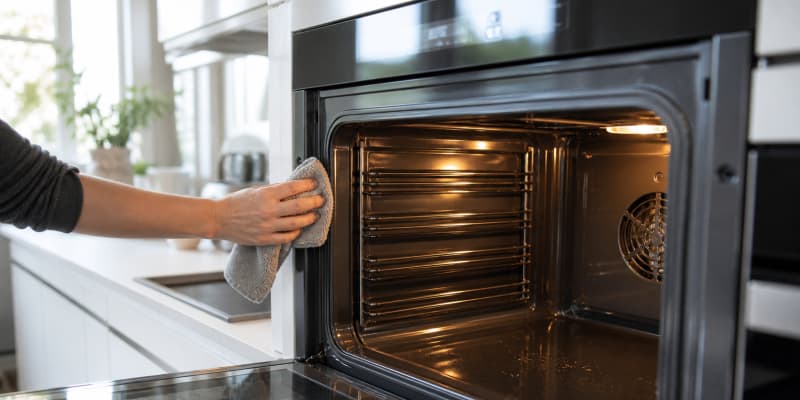
Miele ovens use two very different interior surfaces — PerfectClean (a smooth silvery non-stick enamel) and pyrolytic (a matt black self-burning liner). Miele customers often assume both surfaces can take the same treatment, and this is where expensive mistakes happen: a caustic cleaner on PerfectClean permanently damages the nano-coating, while pyrolytic cycles run with FlexiClips still fitted anneal the ball bearings. Learning how to clean a Miele oven means using the right method for the right liner; the wrong one can ruin either. Confirm your interior before you spray, scrub or press start.
Quick answer
To clean a Miele oven, identify the interior first. PerfectClean liners are wiped with warm soapy water only — never abrasive cleaners, bicarbonate paste, or caustic sprays. Pyrolytic liners use the Pyrolytic clean cycle in the menu with all shelves, FlexiClips and FoodProbe accessories removed. Both benefit from a warm wipe-down after each cook. Miele combi-steam ovens need regular descaling with Miele descaling tablets — never white vinegar.
Identifying your Miele
- PerfectClean — smooth silvery-grey non-stick surface; no self-clean setting
- Pyrolytic — matt black enamel with a Pyrolytic clean menu option
- Some models combine PerfectClean on the shelves with pyrolytic walls
- Steam-only ovens (DG range) — stainless steel interior; descaling instead of cleaning
Look at the manual or the model number — a P suffix usually means pyrolytic (e.g., H 7264 BP). The model plate is on the door jamb, visible with the door open.
PerfectClean method
The PerfectClean surface is a factory-applied nano-coating. Its whole selling point is that food does not bond to it — which means anything abrasive destroys the coating and cannot be repaired. Miele are explicit in the manual about what to avoid.
- Let the oven cool to hand-warm.
- Wipe the interior with a soft cloth and warm soapy water.
- For heavier soiling, use a Miele-approved oven cleaner or a small amount of washing-up liquid.
- Rinse with clean water and dry with a soft microfibre.
- Never use bicarbonate paste, wire wool, or standard oven cleaner — all damage the coating.
For stubborn spots on PerfectClean, a slightly damp e-cloth used gently in circular motions lifts residue without abrasion.
Read also: How to clean a Neff oven
Pyrolytic self-clean
- Remove all shelves, FlexiClips runners and any FoodProbe accessories.
- Wipe out loose debris and any large fat pool.
- Select Pyrolytic in the menu and choose Level 1 (lightly soiled) up to Level 3 (heavy).
- Cycle runs for 1h30 to 2h30 with an automatic door lock.
- Once cool, wipe the powdery ash with a damp cloth.
- Wash shelves separately in the sink with hot soapy water.
Cleaning the door glass
- Miele CleanGlass doors have a removable inner pane
- Slide the securing brackets at the top to release the inner glass
- Wash flat on a towel with warm soapy water and a soft cloth
- Dry with a lint-free cloth and refit — align top and bottom before pressing
- Never twist or force the inner pane — align it perfectly before sliding
Read also: How to clean a Bosch oven
Cleaning FlexiClips runners
These telescopic rails are removable and one of Miele’s premium features. Soak in warm water with dishwasher powder for 30 minutes, then rinse and dry immediately. Never leave them wet — the ball bearings inside the rollers rust. Apply a very light dab of food-safe grease to the tracks once they are dry (Miele sell an approved lubricant, but a smear of vegetable oil works in a pinch). Never send FlexiClips through the pyrolytic cycle.
Read also: Pyrolytic oven cleaning explained
Steam ovens and combi-steam Miele models
Miele combi-steam ovens need descaling regularly, especially in London’s hard-water areas.
- Use Miele descaling tablets, never white vinegar or citric acid
- Run the DescaleAgent cycle from the menu — approximately 25 minutes
- Rinse the water tank and water pipe afterwards with fresh water
- Wipe out condensate residue after each steam cook
- Empty the water tank between uses to prevent stagnation
Care schedule
For PerfectClean models, wipe out with a soft damp cloth after every cook while the oven is still hand-warm. Deep clean with warm soapy water and a Miele-approved cream every fortnight in an averagely used household. For pyrolytic Miele models, run the low pyrolysis setting monthly and a full Level 3 cycle every three months. Combi-steam users should descale as the appliance prompts — usually every four to six weeks in hard-water areas.
Cleaning the exterior and controls
Miele stainless steel fronts show fingerprints instantly. Wipe with a slightly damp microfibre in the direction of the grain, then buff dry with a lint-free cloth. Miele sell an approved stainless steel spray that removes marks without oil residue. For M Touch and MotionReact touch controls, wipe with a barely-damp cloth only — never spray any liquid directly onto the panel. If a wet cloth accidentally activates the touch panel, unplug briefly to reset.
What never to use in a Miele
- Caustic oven cleaner sprays on PerfectClean surfaces
- Wire wool or Brillo pads
- Steam cleaners directed at controls
- Bleach on any metal component
- Bicarbonate of soda paste on PerfectClean — the mild abrasion still damages the coating
- Vinegar in a steam oven — the acidity damages the water heater
Conclusion
Miele’s finishes reward gentle, consistent care above all else. Warm wipes after every cook, Miele-approved cleaners only, and the pyrolytic cycle used monthly rather than yearly — that is the whole recipe for a Miele that lasts twenty years. For an annual professional deep clean that respects PerfectClean, book a visit at Maggie’s oven cleaning in London.
