
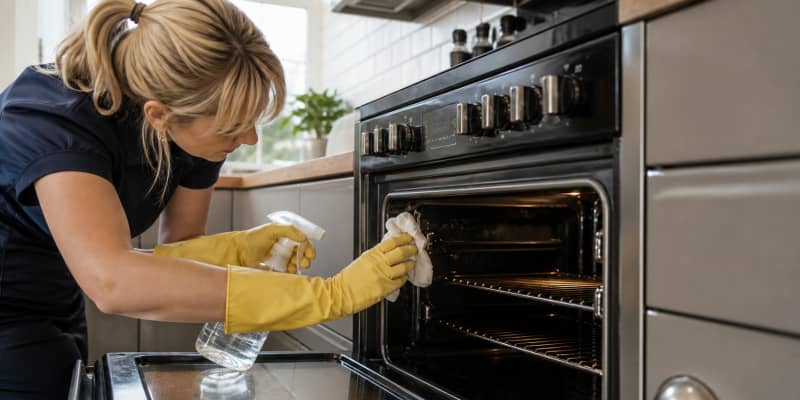
Belling range cookers are found in kitchens across the UK, from compact 90 cm models sitting in Victorian terraces to grand 110 cm dual-fuel giants anchoring open-plan family kitchens. They are built to be used hard and, with the right care, last twenty years or more. Learning how to clean a Belling oven — hob, grill and multiple cavities — keeps it looking fresh, cooking evenly and passing tenancy inspections. The trick is treating each cavity and surface a little differently, because Belling range cookers pack quite a lot of variety into one appliance.
Quick answer
To clean a Belling range cooker, cool completely and remove all shelves and side rails. Apply a paste of six tablespoons of bicarbonate of soda and warm water to the enamel interior of each cavity, leave overnight, and wipe out with a damp microfibre. Soak shelves in the bath in hot water with soda crystals or two dishwasher tablets. Clean the ceramic hob with Cerapol or Hob Brite, or the gas burners with hot soapy water. Never use caustic sprays on the enamel.
Belling cavity types
- Main oven — usually a multi-function fan cavity
- Tall oven — conventional, often houses the grill on smaller models
- Grill cavity — separate cavity with fold-down door on larger models
- Warming zone — low-heat drawer or shelf on some models
- Catalytic side panels — on higher-end Cookcentre models, self-clean at 200 °C+
Each has an enamel interior tolerant of bicarbonate but not of caustic cleaners.
Read also: How to clean a Rangemaster range cooker
Deep cleaning the main oven
- Remove all shelves, side racks and any pizza stones.
- Wipe out any loose debris with a paper towel.
- Mix 6 tablespoons of bicarbonate of soda with enough warm water to form a spreadable paste.
- Spread over walls, floor and ceiling. Avoid the fan cover and top element.
- Leave overnight — at least twelve hours for stubborn build-up.
- Wipe away with a damp microfibre.
- Spray any stubborn spots with white vinegar to lift by fizzing.
- Rinse with clean water and dry with a tea towel.
Cleaning the grill and tall oven
The grill pan and rack take the most punishment. Soak them in the bath filled with hot water and two dishwasher tablets for two hours. Scrub with a nylon brush. Wipe the tall oven interior with bicarbonate paste as above. The grill element itself is self-cleaning under normal use — do not spray any cleaner directly onto the element. If the pan support wire mesh looks dark and impossible to clean, replacement wire meshes are available from Belling spares (five to ten pounds).
Read also: How to clean a Stoves range cooker
Gas hob care
- Lift the cast iron pan supports off carefully
- Remove the burner caps and heads — they usually just lift off
- Soak all removable parts in hot soapy water for an hour
- Clear each burner port with a pin or thin wire — a blocked port causes a lopsided flame
- Wipe the hob surface with warm soapy water
- Dry every part fully before reassembly — a damp burner will not light
- Refit each cap onto its correct base — mismatched caps produce yellow flames
Ceramic and induction hob care (dual-fuel Belling)
For dual-fuel Belling models with a ceramic or induction top:
- Use hob cream (Hob Brite or Cerapol) on a soft cloth
- Scrape hardened deposits at a 30-degree angle with a plastic hob scraper
- Never use scouring pads or caustic sprays
- Wipe up sugar and jam spills the moment you notice — they etch cool glass in minutes
Read also: Buying a range cooker guide
Cleaning the door glass
- Open the door fully.
- Press the two locking clips at the top of each hinge.
- Lift the door off — the weight surprises first-timers, so brace with both hands.
- Lay flat on a towel and slide the retaining strip at the top to release the inner glass.
- Apply bicarbonate paste to the inner glass.
- Leave 30 minutes, wipe clean, refit into hinge slots and lock clips.
Splash panel and control fascia
The stainless steel splash panel behind a Belling picks up spatters that dry into stubborn brown spots. Wipe daily with a warm damp cloth and buff with a microfibre in the direction of the grain. For the control fascia and dials, spray a mild all-purpose cleaner (Method or Ecover) onto a cloth first, never directly onto the panel. Water behind the dials can short out the ignition on gas models.
Common Belling issues and fixes
Yellow flames on a gas burner after cleaning almost always mean a burner cap is mismatched or seated poorly — lift and refit each cap onto its correct base. A grill that lights but does not heat suggests thermocouple contamination; wipe the small silver rod alongside the grill flame with a barely-damp cloth once cool. A door that no longer closes flush usually has a piece of food lodged in the seal — trace round the rubber gasket with a cotton bud and clear the debris. And a fan oven that heats unevenly may just need the shelves rearranged; Belling ovens work best with dishes on the middle two shelves, not top and bottom together.
Preventing build-up
- Wipe the hob and enamel surround after every cook while still warm
- Cover pans with a lid when frying to reduce splatter
- Line the bottom shelf with a reusable oven mat during roasts (never on the base itself)
- Empty and rinse the grill pan after every use
- Take burner caps off monthly for a proper soak
Conclusion
A Belling stays reliable for two decades with the right care — bicarbonate paste for the enamel, hot-water soak for the shelves and grill pan, and Hob Brite for the ceramic top. For a full annual deep clean, including door glass strip-down and interior degrease, book a service at Maggie’s oven cleaning in London.
