
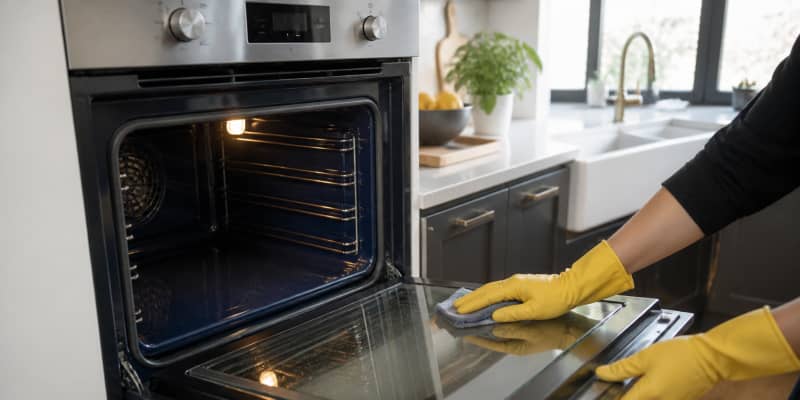
Pyrolytic oven cleaning has become the flagship feature on most premium kitchen ranges – and for good reason. It reduces grease and food splashes to ash without a single scrub, which sounds like magic until you understand the chemistry: 480 degrees Celsius is hot enough to break down almost any organic residue into carbon dust. If you are shopping for a new oven or unsure how to make the most of one you already have, this guide covers everything you need to know, including a few things the sales assistant probably will not have told you.
Quick answer
Pyrolytic oven cleaning heats the interior to around 480 degrees Celsius, incinerating food residue into a light ash you sweep out. A cycle takes 2 to 4 hours, uses roughly 3 to 5 kWh of electricity, and works best when run every 2 to 3 months on a lightly soiled cavity. Remove racks first unless the manual says otherwise, and ventilate the kitchen throughout.
What is a pyrolytic oven?
Pyrolytic simply means “by fire”. A pyrolytic self cleaning oven has reinforced insulation, a heat-resistant seal, and an automatic door lock that engages during cleaning. Once the cycle starts, the oven heats far above normal cooking temperatures, safely burning off grease inside a sealed chamber. The result is a fine grey ash – equivalent to the volume of a teaspoon after a normal cycle – which you sweep out with a damp cloth.
Read also: How to Use a Self-Cleaning Oven Safely
How pyrolytic cleaning compares to other systems
There are three main self-clean approaches, and knowing the difference helps you decide what is best for your kitchen.
- Pyrolytic: incinerates residue at 480 degrees Celsius – best for heavy users
- Catalytic: coated liners absorb grease at 200 degrees Celsius – needs replacement over time
- Steam: water and heat soften light soil at 100 degrees Celsius – gentle but only for surface grime
Best pyrolytic oven brands
On the UK market, brands such as Bosch, Neff, Siemens, Miele, AEG, and Samsung all offer strong pyrolytic ranges. Higher-end models add a food probe, self-drying after a steam cycle, and voice or app controls. Look for triple-glazed doors and A+ energy ratings if efficiency matters to you. Miele consistently tops user surveys for reliability, though Bosch offers similar performance for less money.
How to run a pyrolytic cleaning cycle
The process is straightforward once you have used it once or twice.
- Remove racks, side rails, and any accessories (some are pyro-safe – check the manual).
- Wipe the door seal with a damp cloth to protect it from ash sticking.
- Open a window and put the extractor fan on medium.
- Choose a cycle length – light for regular users, heavy after Christmas roasts.
- Wait for the door to unlock before opening (this can take up to an hour after the cycle ends).
- Wipe out the fine ash with a damp microfibre.
Read also: How to Clean a Steam Oven Correctly
Energy use and cost
A pyrolytic cycle uses somewhere between 3 and 5 kWh, depending on the length and the model. At current UK electricity prices, that works out to roughly 90p to 1.50 pounds per cycle. Run three or four times a year, the annual energy cost is genuinely modest – much less than the cost of a single professional deep clean, though the trade-off is that it does not touch the door, racks, or outer casing.
Common questions about pyrolytic self cleaning oven use
Is it safe? Yes, when used according to the manual. The door lock cannot open until the interior cools below 300 degrees Celsius. Are the fumes toxic? A small amount of odour is normal, but heavy chemical fumes suggest packaging or plastic left inside – abort the cycle. Does it use a lot of energy? Around one full roast dinner’s worth, so it is not something to run weekly. Can you cook straight after? Yes, but a 15-minute empty run at 200 degrees Celsius helps clear any lingering ash smell.
What pyrolytic cleaning does not do
The cycle only cleans inside the oven cavity. The door glass often stays streaky, the exterior stainless steel needs polishing separately, and the hinges and outer seal need hand-cleaning. Racks are best cleaned separately unless yours are pyro-safe – most modern chrome-plated racks discolour if left inside during a cycle.
Read also: How to Clean Oven Racks in 30 Minutes
Common mistakes to avoid
Leaving oven racks in during a cycle is the most common mistake – it discolours the chrome and can warp thinner shelves. Running with any aluminium (foil, disposable trays) inside is another disaster – it melts and bonds to the enamel. Ignoring ventilation is a third: even a well-maintained oven produces some odour on the first cycle after heavy use, and anyone with respiratory sensitivity will suffer.
How often to run pyrolytic cleaning
For an average family that roasts weekly, once a quarter is plenty. Heavy home cooks doing multiple roasts a week can run one every 6 to 8 weeks. Small households that mainly use the microwave can go 6 months between cycles. Watch for build-up on the ceiling above the fan – that is the first sign the interior needs another cycle.
Conclusion
Pyrolytic cleaning is one of the most useful features on a modern oven – as long as you combine it with regular hand-cleaning of the parts it cannot reach. For a full detail including racks, glass, and hinges, our team offers a professional non-caustic oven cleaning service in London that works alongside your pyrolytic cycle.
