
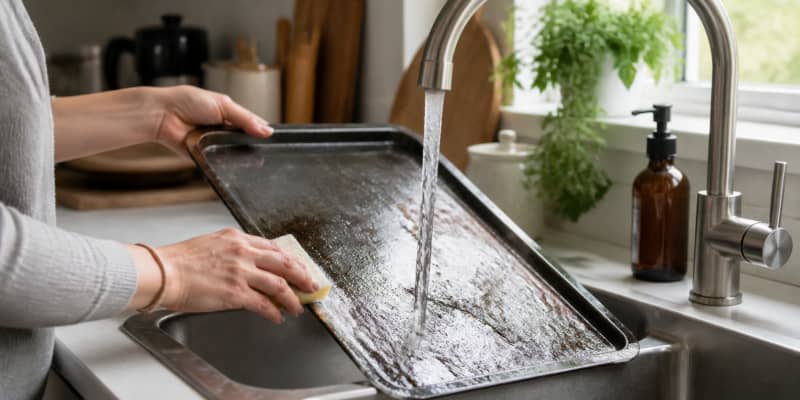
Baking trays live a hard life – high heat, sticky sugars, and greasy roasting fats slowly turn shiny aluminium into something closer to burnt caramel. Knowing how to clean baking trays properly saves you buying new ones every year, and a well-cared-for tray from John Lewis or Lakeland should last a decade of Sunday roasts. These methods work whether your pans are aluminium, non-stick, or stainless steel, and every ingredient is likely already in your cupboard.
Quick answer
To clean baking trays, sprinkle two tablespoons of bicarbonate of soda and drizzle white vinegar over the surface, leave for 30 minutes, then scrub with a non-scratch pad and rinse. For badly baked-on food, boil water with a dishwasher tablet directly in the tray on the hob for 5 to 10 minutes. Never use wire wool on non-stick coatings – it destroys the surface in seconds.
Tools you’ll need
Most of this is already in your kitchen. Keep a small kit under the sink for a Saturday morning tray rescue.
- Bicarbonate of soda
- White vinegar
- Washing-up liquid (Fairy or Ecover)
- A non-scratch scouring pad
- Bar Keepers Friend for stainless and aluminium (never non-stick)
- A dishwasher tablet for stubborn burns
The best way to clean baking trays (baking soda and vinegar)
The classic combo works because baking soda is a mild abrasive alkaline, and vinegar loosens grease bonds when it fizzes. Sprinkle two tablespoons of bicarbonate across the tray, splash over enough vinegar to bubble it up (about a quarter cup), and leave for 30 minutes. Scrub in circular motions with the rough side of a sponge and rinse under hot water. For thicker stains, repeat with a second application.
Read also: How to Clean Oven Racks in 30 Minutes
How to get baked on food off pans (the boiling method)
For that black crust that survives soaking, this cleaning baking sheets trick is our favourite. Set the tray on the hob, half fill with water, add a dishwasher tablet or a scoop of washing soda, and bring to a simmer for 5 minutes. The heat and alkali dissolve the carbon. Tip out, cool, and wipe. This method is safe for stainless steel and aluminium but not for non-stick, which reacts poorly to strong alkalines at high heat.
Bar Keepers Friend for shine
Once the crust is gone, Bar Keepers Friend Powder restores metal shine like nothing else. Sprinkle onto a damp tray, rub in circles with a wet cloth, and rinse thoroughly. Never use it on non-stick – only bare aluminium or stainless steel. One tin lasts for years in a typical household.
How to clean oven trays without harsh chemicals
If you would rather not use synthetic cleaners, these natural options handle most of what a home baker throws at a tray:
- Lemon halves rubbed with salt – great on aluminium
- Cream of tartar paste with hot water – removes brown discolouration
- Ketchup – the acids in tomato paste cut through grease on stainless steel
- Effervescent denture tablets in warm water – surprisingly effective
- Citric acid dissolved in hot water – excellent on aluminium roasting tins
Read also: How to Remove Burnt-On Grease from Your Oven
Cleaning non-stick baking trays safely
Non-stick coatings need a much gentler touch. Never use scourers, wire wool, or alkaline sprays. Instead, soak in hot water and washing-up liquid for 20 minutes, then wipe with a soft sponge. For stubborn spots, a paste of baking soda and water applied gently with a fingertip lifts residue without scratching. Once the coating is scratched, no cleaning method will restore it – the tray will need replacing.
Step-by-step baking pan cleaning
Here is a reliable routine for how to clean baking pans that are well past their prime.
- Fill the sink with very hot water and a squirt of washing-up liquid.
- Soak the tray for 15 minutes to soften grease.
- Sprinkle baking soda across, add a splash of vinegar.
- Scrub with a nylon pad – never wire wool on non-stick.
- Rinse well and dry immediately to prevent water spots.
- Buff with Bar Keepers Friend if you want a mirror finish (metal only).
Keeping trays cleaner for longer
Line trays with reusable silicone mats or baking parchment. Wipe warm (not hot) after each use with a soapy cloth. Never leave a used tray in the sink overnight – dried food is ten times harder to shift. If a tray has developed a permanent brown tint but is otherwise clean, that is oxidation, not dirt – it does not affect cooking.
Common mistakes to avoid
Putting warm trays straight into cold water is the fastest way to warp thin aluminium. Using bleach damages both the metal and any coating. Stacking wet trays traps moisture and causes staining. And leaving vinegar in contact with aluminium overnight can etch the surface – always rinse promptly.
Read also: Cleaning Your Oven with Vinegar and Baking Soda
Conclusion
With the right method, even the worst-looking baking tray can be brought back from the brink. If your entire oven, racks, and trays need a full reset, our team offers a complete oven cleaning service across London that includes dip-tank cleaning for every removable part.
