
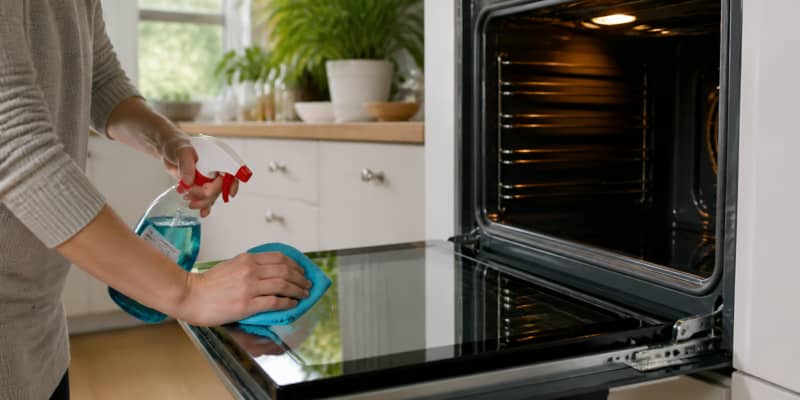
Neff ovens are beautifully engineered but the Slide & Hide door and pyrolytic liners need very specific care. The retractable door slides under the oven cavity on a set of rollers — an inspired piece of design when you are basting a roast, but a nightmare if grease works its way into the hinge mechanism. Learning how to clean a Neff oven correctly protects the CircoTherm fan, the enamel liner and the door rollers, and keeps this premium appliance performing for the fifteen-plus years Neff engineers have in mind. Get it right and Sunday lunch prep never involves a wrestling match with a hot oven.
Quick answer
To clean a Neff oven, start with the pyrolytic self-clean cycle if fitted — remove all shelves, telescopic runners and side rails first, then select Pyrolyse from the menu (Level 1 at 75 minutes for light soiling, Level 3 at 150 minutes for heavy). Once cool, wipe out the fine ash with a damp microfibre. For non-pyrolytic models, apply a paste of bicarbonate of soda and warm water overnight and wipe away. Never use oven cleaner sprays anywhere near the Slide & Hide door hinges.
Neff Slide & Hide door — care basics
The Slide & Hide door retracts under the oven and rides on a set of steel rollers. Getting oven cleaner into the roller mechanism causes it to seize or run rough, and a rough door mechanism is one of the most expensive Neff repairs. Clean the glass with the door in the closed position for the inside pane, then retracted for the outside pane, so nothing pools at the hinges. Wipe up spills that fall on the door immediately, not later.
Read also: How to clean a Bosch oven
Using the pyrolytic cycle
- Remove the wire shelves, telescopic runners and side rails — none of these are pyrolytic-safe.
- Wipe out any loose crumbs or large spills — pyrolysis converts liquid grease to fine ash, but larger fragments smoke heavily.
- Close the door fully — the lock engages automatically once the cycle starts.
- Select Pyrolyse from the menu. Choose Level 1 for light soiling (75 min) or Level 3 for heavy (150 min).
- Ventilate the kitchen while the cycle runs — trace smoke and odour are normal.
- Once cool, wipe out the powdery ash with a damp cloth.
- Wash the shelves separately in warm soapy water with soda crystals.
Manual cleaning for non-pyrolytic Neff
For CircoTherm and Slide & Hide models without pyrolysis, use the bicarbonate method — Neff explicitly recommend against caustic cleaners on their enamel.
- Mix a paste of bicarbonate of soda and warm water — six tablespoons of powder is enough for a large oven
- Spread over the interior — avoid the fan cover and elements
- Leave overnight (12 hours minimum)
- Wipe away with a damp cloth
- Spray any remaining paste with white vinegar to help lift
- Rinse with clean water and dry
Read also: How to clean a Miele oven
Cleaning the glass door
- Open the door and press the two locking clips on the hinges.
- Lift the door off carefully — Neff doors are heavy and awkward.
- Lay it flat on a folded towel on a stable surface.
- Slide the retaining strip at the top of the door to release the inner glass pane.
- Apply bicarbonate paste to the inner glass and leave 30 minutes.
- Wipe clean, dry, refit the inner pane, and clip the door back into the hinge slots.
Never immerse a Neff Slide & Hide door in water — the sealed edge is not designed for submersion and water will migrate into the roller mechanism.
Cleaning racks and telescopic runners
- Soak in the bath in hot water with two dishwasher tablets (Finish Quantum) for two hours
- Scrub with a nylon brush
- Dry telescopic rails immediately to prevent rust
- Apply a light dab of food-safe grease to the runners if they feel stiff — Neff sell an approved lubricant for this
- Never send telescopic runners through the pyrolytic cycle — the ball bearings anneal and jam
Read also: Pyrolytic oven cleaning explained
CircoTherm fan care
CircoTherm is Neff’s signature circulating fan system — the same principle as a convection oven but with a ring element that heats the air before it reaches the food. The fan cover is easily scratched, so clean it with a soft cloth and warm soapy water only. Never use wire wool. If pyrolysis has left ash inside the fan cover, wipe with a slightly damp cloth after the cycle. Do not remove the cover unless you are a service technician; the screws are secured with thread-lock.
Common mistakes
- Using oven cleaner spray on the Slide & Hide mechanism
- Running pyrolysis with the shelves still inside — they discolour and warp
- Cleaning the fan cover with wire wool — it scratches the enamel
- Ignoring the rubber door seal — wipe monthly with a soft cloth
- Attempting pyrolysis with heavy fat pooled on the base — remove first with a paper towel
How often to run pyrolysis
Pyrolysis is a high-energy cycle and Neff recommend using it no more than once every four to six weeks in an averagely used oven. A pyrolytic clean is not a substitute for wiping spills quickly — it is for the once-a-month reset. Between cycles, a warm wipe after every roast (once the oven has cooled to hand-warm) keeps residues from building up.
Conclusion
Treat the Slide & Hide door carefully and let the pyrolytic cycle do the heavy lifting where fitted. Monthly reset with pyrolysis or bicarbonate, quick wipes after each cook, and never a spray of caustic near the hinges — a Neff will last decades. For an annual deep clean that reaches inside the fan cover and door glass, book a professional at Maggie’s oven cleaning in London.
