
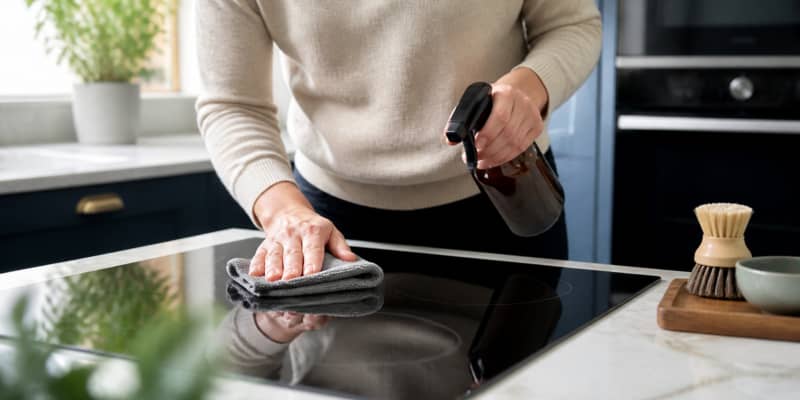
An induction hob is one of the tidiest surfaces in the kitchen when it is clean, and one of the most stubborn once anything sugary hits it. Learning how to clean induction hob glass properly, without scratching the surface or leaving hazy streaks, keeps the cooktop looking as sharp as the day it went in. This guide covers the daily wipe, the burnt-on incident, and the deep clean, using cleaners that are safe on the ceramic surface.
Quick answer
To clean an induction hob, wait until it has fully cooled, wipe with a damp e-cloth and a drop of washing-up liquid, then polish dry with a soft microfibre cloth. For burnt-on food, apply a dedicated induction hob cleaner such as Cerapol or Hob Brite, leave for two minutes, and lift residue with a razor scraper held at a shallow angle.
Induction hob vs gas: why cleaning is different
An induction cooktop looks like a ceramic hob but heats differently. The magnetic field inside the pan does the cooking, which means the glass itself stays cooler and food rarely burns hard onto the surface. That is the good news. The bad news is that any sugar that does hit the hot ring, or any spill from a pan that boils over, sets fast onto smooth glass and stays put unless you catch it early. Because there are no burners or grates to hide behind, every mark is visible. Induction hob vs gas comes down to this: an induction hob is easier to clean daily but less forgiving of neglect.
Read also: How to clean a ceramic hob
What you’ll need
- A soft e-cloth or microfibre — never a scourer
- Washing-up liquid — Method or Ecover
- A dedicated induction hob cleaner: Cerapol, Hob Brite or Bar Keepers Friend Ceramic Cook Top Cleaner
- A razor scraper designed for glass hobs (held at 15 degrees)
- Distilled or filtered water for a streak-free finish
Step-by-step: daily clean
- Wait until the hob has fully cooled and the residual heat indicator has gone off. Cleaning a warm induction hob smears rather than lifts.
- Wipe the whole surface with a damp e-cloth to lift loose crumbs.
- Add a drop of washing-up liquid to a clean damp cloth and wipe again in small circles.
- Rinse the cloth in warm water, wring it out, and go over the surface a third time to remove suds.
- Polish dry with a fresh microfibre. Distilled water on the rinse cloth avoids limescale streaks in hard-water areas.
Step-by-step: burnt-on food
- Do not attack the mark while the hob is still warm. Wait until it is cold.
- Apply a small amount of induction hob cleaner such as Cerapol or Hob Brite directly to the mark.
- Leave for two to three minutes so the cream can break the bond.
- Hold a razor scraper flat, at about 15 degrees to the glass, and glide it under the residue. Never dig in with the corner.
- Wipe the loosened residue with a damp e-cloth.
- Reapply a thin film of cleaner and buff with a dry microfibre. This leaves the polish that stops the next mark bonding as hard.
Read also: How to clean a gas hob and burners
What not to do
Do not use a scourer
Green scourers scratch ceramic hobs. Even a non-scratch pad can leave a haze on the glass that shows up under kitchen downlights.
Do not use oven cleaner
Caustic sprays designed for ovens damage the print on hob touch controls and dull the glass.
Do not drag pans
Cast-iron pans dragged across the surface leave grey marks. Pick them up and place them down.
Do not skip the polish
The thin film left by a proper hob cleaner is what makes the next spill wipe off in seconds.
Long-term care
An induction hob rewards habit. Wipe after every cook while the surface is cold. Reapply hob cream once a week as a polish, not just when there is a mark. Keep sugar off the surface where you can — a boiling-over jam pan is the classic disaster because sugar bonds to the glass in a way that grease never does. If the print on the touch controls starts to fade, switch to distilled water on your wiping cloth; the minerals in London tap water are what wear the print.
Choosing the right cloth
The single biggest cause of hazy induction glass is the wrong cloth. Terry-towel tea towels shed fibres that catch under the polish film. Paper kitchen roll is fine for quick dry-off but leaves lint on the final buff. A dedicated e-cloth or a plain microfibre reserved for the hob is what stops streaks. Wash cleaning cloths without fabric softener — softener leaves a residue that transfers back to the glass and dulls the shine within days.
Conclusion
The best induction hob cleaner is the one you use often, gently, and always on a cold surface. Cerapol, Hob Brite and Bar Keepers Friend all work when applied properly and buffed off with microfibre. For a really neglected surface, or for a hob you have inherited with scratches and haze, book our appliances cleaning service in London and we will restore the glass without abrasion.
